

Wondering how to get around Ho Chi Minh City like a local?
We’ve spent over a year in Ho Chi Minh City, and most of the time, we lived in District 9, about an hour away from the city center. We still went into the city a lot, meaning we learned our way around transportation in Ho Chi Minh City.
We’ve always rented or bought a motorbike while staying in the city because it’s nice to have the freedom to go wherever you want. However, we also used all the other transportation in Ho Chi Minh City. Depending on your comfort, you’ll likely use a mix of these different transportation methods.
In this article, I’ll answer how to get around Ho Chi Minh City, including what rideshare apps to use, information about the brand-new Ho Chi Minh City metro, and more.

7 Ho Chi Minh City Transportation Methods (ranked from most convenient to least)
These are the seven main ways to get around Ho Chi Minh City, ranked loosely from most convenient to least convenient (from the perspective of the average backpacker or tourist). We’ve done all of this and have gone to almost every corner of the city, so we will also give some important tips with each.
#1. Walk (around the city center)
The first time I visited Saigon, I took a bus from Mui Ne after traveling through the entire country, starting in Hanoi. The bus dropped me off downtown at September 23rd Park, only a 10-minute walk from my hostel.
I only stayed in the city for 3 days that trip and walked everywhere. If you’re only in HCMC for a short amount of time, don’t feel comfortable in the crazy traffic, and don’t mind a lot of walking in the Saigon heat, you can get to a lot of the main places on foot.

Places in the city center you can easily walk to
If you want to stick to the safety of the streets in HCMC, here are some popular things to do that are all within walking distance from one another (a 10-45 minute walk, depending on the location):
- Bui Vien Party Street
- September 23rd Park
- Saigon Central Post Office
- Notre Dame Cathedral of Saigon
- Ben Thanh Market
- Ben Nghe Street Food
- War Remnants Museum
- Independence Palace
- Saigon Opera House
- Nguyen Hue Walking street
- Saigon Riverfront
Most of the HCMC museums are in the city center, so it’s easy to explore those. Just remember that even if you’re just walking around, you’ll still have to deal with the Saigon traffic. Doing things as simple as crossing the road is chaotic, and motorbikes on the sidewalks aren’t completely unheard of.

How about riding a bicycle in the city center?
I almost gave bicycling its section in this HCMC transportation guide, but it isn’t worth it. There are city bike stations sporadically throughout the city, but I highly advise against riding a bike unless you’re going with a tour guide who knows the road well.
Traffic makes things complicated; there’s always traffic, and being on a bicycle is probably even more dangerous than being on a motorbike. You don’t see it often, and it’s probably more stress than it’s worth.
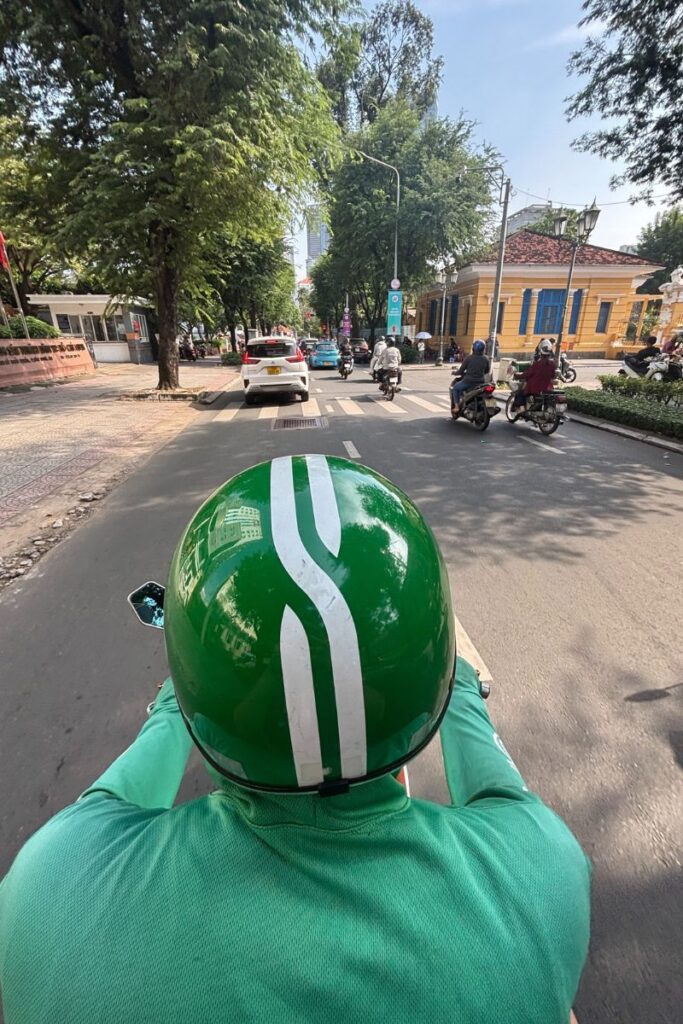
#2. Take Grab or motorbike taxi
Grab is the #1 rideshare app in Vietnam and one of the most useful apps for travelers in Southeast Asia. In Vietnam, you can call a Grab motorbike taxi to take you anywhere you want. Within the city center, rides usually cost around $1 USD (or under 30,000 VND).
To call a rideshare, just open the app, enter your pick-up and drop-off destinations, and wait for a motorbike to pull up. They usually have matching jackets and helmets with their company (Grab helmets and jackets are bright green). They also will have a second helmet for you, so you have to wear this helmet (and remember to give it back when you get off. I’ve tried to walk away once or twice with their helmet).
You can pay with cash (Vietnamese dong is preferred) or set up a credit card before booking. Most rideshare companies have their app set up in English (and Vietnamese), so it’s easy to navigate and create an account. You might need a local number with a local SIM, but some allow you to receive verification through WhatsApp, which is convenient.
The drivers are super experienced and know how to maneuver around the traffic. Some drivers are a little crazy (speeding through the streets, zipping between cars, etc), but I’ve personally never been in an accident with a driver, heard of an accident, or seen one. So, I think they know what they’re doing.
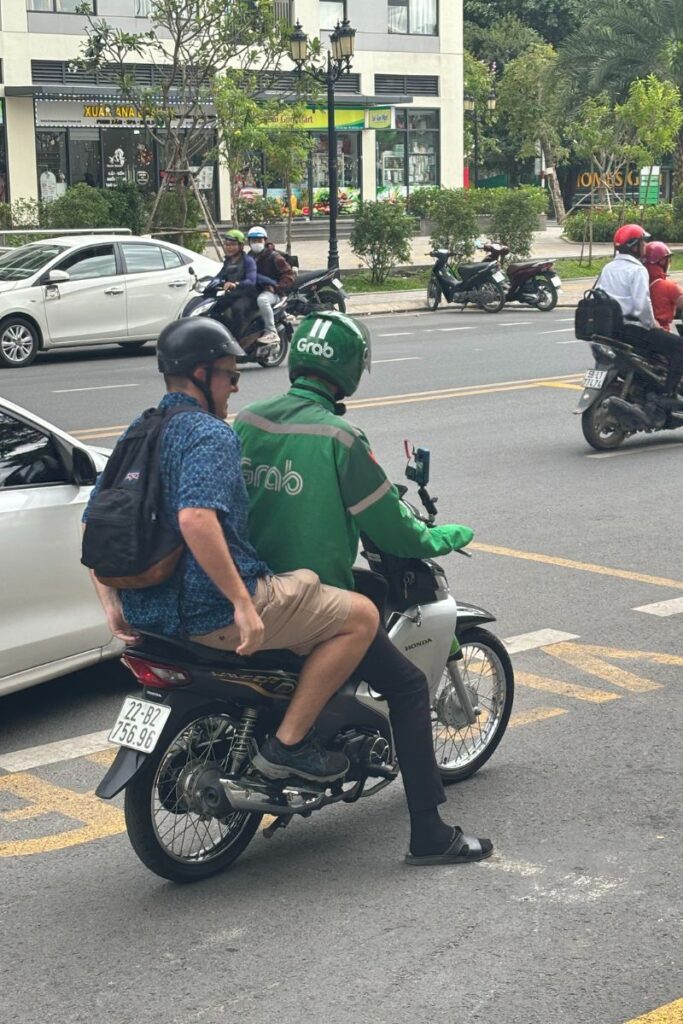
Best rideshare companies to use in HCMC (ones we’ve actually used)
Grab is the most popular app in Vietnam. It can be used for car taxis, motorbike taxis, and food/grocery delivery. It’s also convenient because it’s used in most of Southeast Asia, so if you’re traveling to Phnom Penh, you can use it there, too. However, some other apps are rising in popularity and competing with Grab:
- Xanh SM: These are electric bikes and cars characterized by the bright blueish/green coloring of the taxis and bikes. The company is operated by Vin, the country’s first all-electric taxi company. We stayed near one of the big charging points for cars and bikes, so these were the most affordable options.
- Be: This is another newer competitor that is slowly becoming more popular. You can easily identify them with the bright yellow jacket with blue print.
If you’re a budget traveler or just like a good deal, I recommend downloading Grab, Xanh SM, and Be while in Vietnam. You can then compare prices amongst the three and call whichever is cheapest.
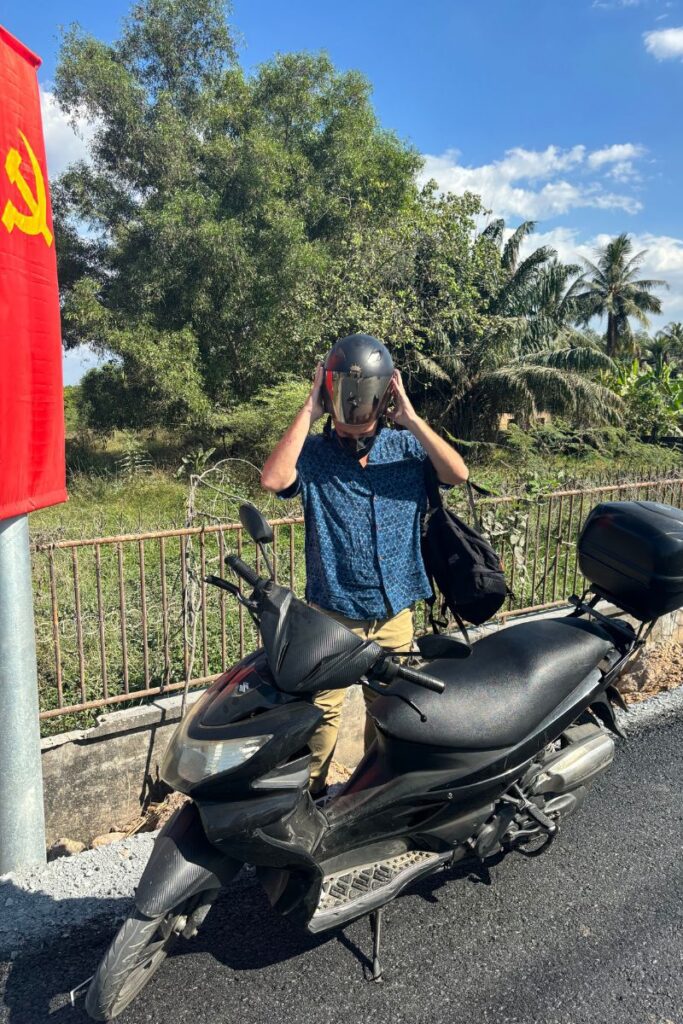
#3. Rent a motorbike and drive
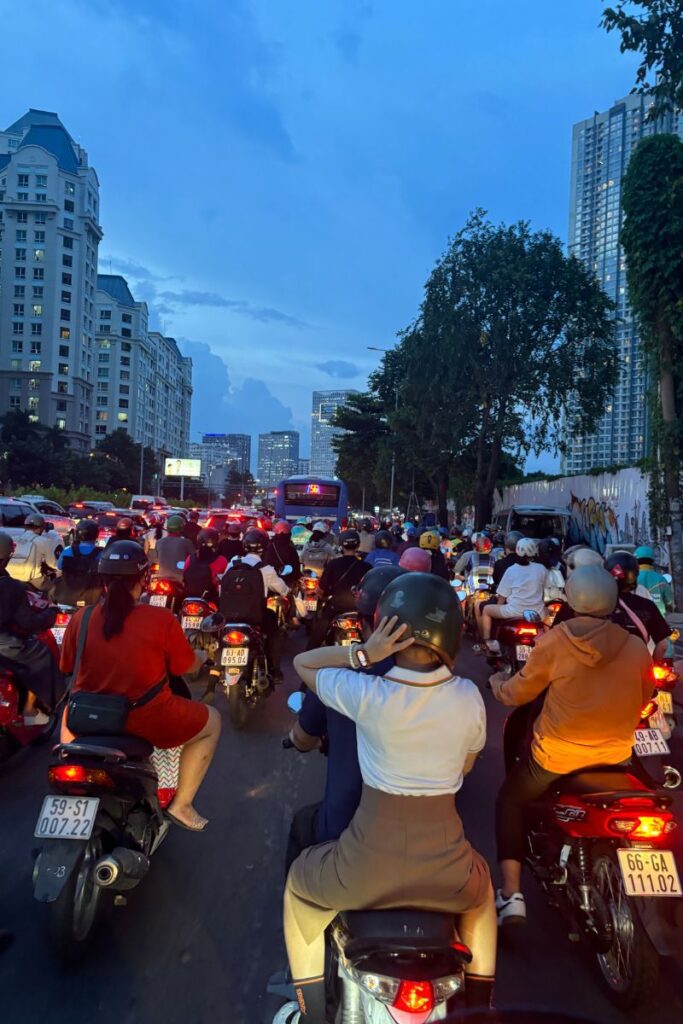
It sounds so simple, but renting a motorbike and driving is one of the best activities in Ho Chi Minh City. It’s not for the faint of heart, especially around rush hour (which is behind when school ends, around 4:30 pm). Motorbike traffic is bumper to bumper, and people appear to drive with no rhyme or reason (though the longer you drive, the more you’ll realize there is some organization to the chaos).
However, it’s also really fun for adrenaline junkies, motorcyclists, and more adventurous travelers. You also have a lot more freedom to venture outside the cities to more off-the-beaten-path locations, like Monkey Island or parts of the Mekong Delta.
There’s easy parking everywhere. Most businesses have small parking spaces in front, and bigger malls have large garages in the basement. There are also private parking lots all over the city for a small fee.
What you need to drive in hcmc
If you’re going to rent and drive a motorbike, you first need a few things.
First, you’ll need a proper licensing. This comes in handy if you get pulled over because you need a license to legally drive a motorbike in Vietnam. It’s also required by all insurance companies if you get in an accident and need help from your travel insurance. The insurance company won’t cover you if you aren’t driving legally.
To drive a motorbike in Vietnam, you need:
- A valid International Driver’s Permit (1968 style): These are available in different ways for different countries. Unfortunately, the 1968 permits are not available in the United States and Canada. They are semi-recently available in Europe. you should double-check if your home country even offers the kind of license available.
- A1 or A2 driving permit: This is a motorcycle license you’ll need to pair alongside the IDP. A1 or A2 determines the type of motorbike you’re licensed to drive.
If you get pulled over by police without an IDP and driving permit, you’ll be subject to a fine ranging from 200,000 VND ($7.88 USD) to 3,000,000 ($120 USD). I think the legal range is between 200,00 ($7.88) and 500,000 VND ($19.70), but some police will ask for a lot more.
Now, a lot of tourists and expats drive in Ho Chi Minh City without proper licensing, but do so at your own discretion. The chances of getting pulled over are pretty low, and if you’re smart, you hopefully won’t get in an accident. But it can be a dangerous game, so I recommend getting the licenses.

Where to rent a motorbike
You can rent a motorbike everywhere. The easiest place is to go through your accommodation. Most hotels, hostels, and guesthouses will either have a motorbike rental service, or be able to call someone to deliver one for you. If that’s not an option, there are tourist agencies all around Bui Vien and September 23rd Park in District 1 HCMC, all of these places rent motorbikes.
If you feel like dealing with the hassle and you’re planning on staying in HCMC for a longer period of time, you can also buy a motorbike and sell it for around the same price when you’re done (assuming no new damage). You can find motorbikes for sale all over Facebook marketplace and in HCMC motorbike buy/sell groups. They usually cost $200-$350 USD, depending on the quality of the bike.

brief tips for riding a motorbike in hcmc
Garrett is the driver in HCMC and he knows his way around the city traffic. We’ve yet to get in an accident (knock on wood), so here are some general tips on driving in HCMC:
- Go slow: Go however fast you’re comfortable with. Other drivers will go around you; they’re used to it. Don’t feel the need to keep a certain speed because other drivers are doing so.
- Don’t make any sudden moves: Don’t jerk, slam on your breaks, or make a sharp, sudden turn when in traffic. It’s harder for other bikes to respond to your movements when you make them so suddenly.
- Don’t hug the right side of the road too closely: People pulling onto the road from a side street usually don’t even look and just come straight out. It’s best to leave a little buffer zone so they aren’t turning right in your lane.
- Don’t hesitate: Drive with confidence and don’t hesitate. Other bikes around you register your movements, whether you realize it or not, so don’t confuse them and complicate things by hesitating to turn or something.
These are just some general tipsThe most important thing is to only drive if you are 100% confident because motorbike accidents are probably the biggest risk in Saigon. The good news is that even though traffic looks like a chaotic mess in HCMC, it’s more beehive-like. There’s some order to the madness and you’ll pick up on it once you start driving.
If you want to get ahead of the learning curve and know how to drive like a local, check out our top 15 tips for driving in Ho Chi Minh City.

#4. Take Grab taxi cars
There’s absolutely nothing wrong with not being comfortable driving a motorbike in HCMC. It’s probably one of the most intimidating places to be on a motorbike in the world (or atleast, up there).
If you don’t want to drive and don’t want to take a Grab motorbike, you can always take a Grab car. These work the same as Uber in the United States. You can call a car with the app (just make sure you select the car) and take it anywhere in the city.
Obviously, cars are more expensive than motorbikes, but they’re still very affordable (especially compared to prices in the United States of America).
TRAVELER NOTE: When getting from HCMC Airport to the city center, you should only call an official Grab motorbike or take the bus. One of the most annoying scams in Vietnam is one where fake Grab drivers stand in front of the airport and try to get you to ride with them for an insanely high fee. Ignore them. Only use the official Grab app to book your ride.
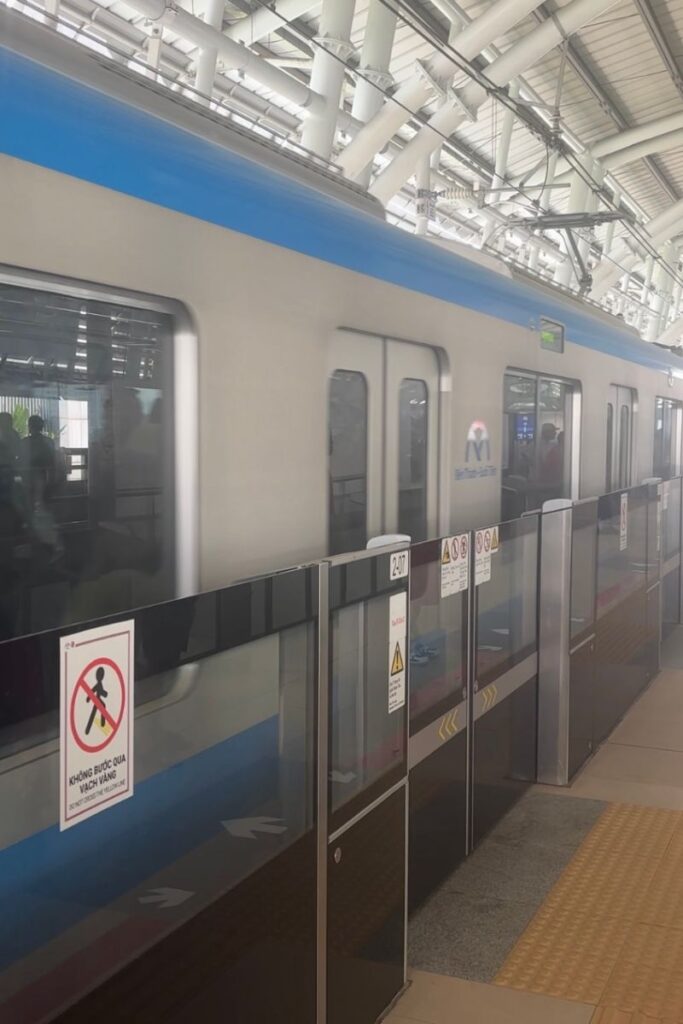
#5. Take the new Ho Chi Minh City Metro
The Ho Chi Minh City metro opened in December 2024 and has been the talk of the city. Construction began for the metro about 15 years ago, and there were long periods of time when no progress was being made at all. I think a lot of people thought it would never open. But it’s here, and it’s very exciting.
The metro doesn’t cover all of the city, but it’s a cool way to explore and get out of the city center for an afternoon.
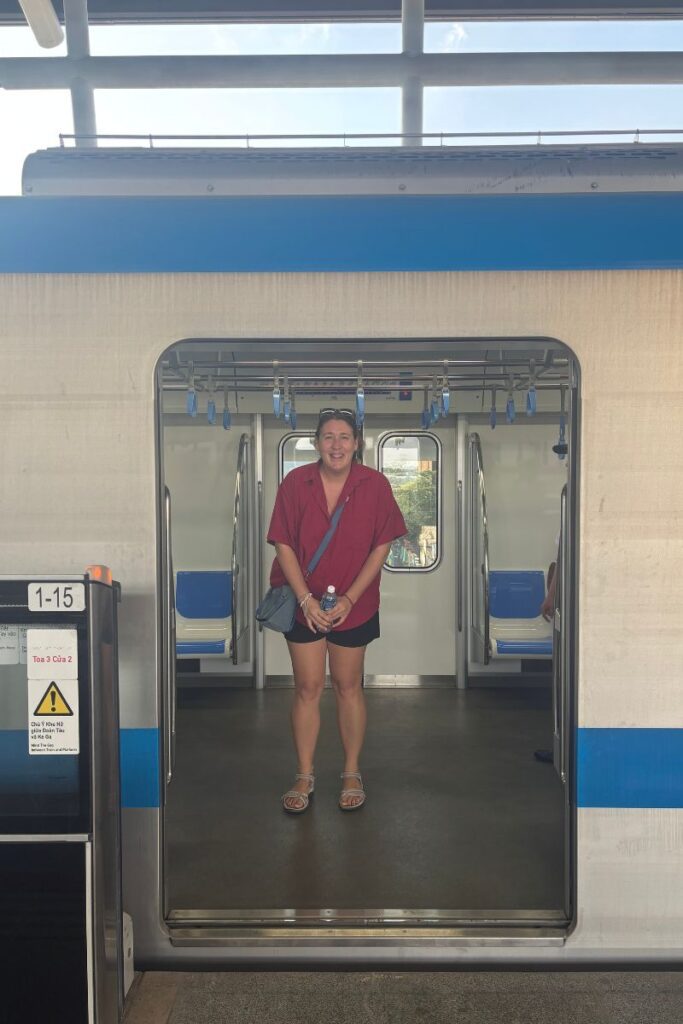
Ho Chi Minh City metro stops
The Saigon metro has 14 stops in total, including Van Thanh Park, Ba Son, Opera House, and Ben Thanh, all of which are right near the city center. There are also two stops in District Two: An Phu and Thao Dien (a popular neighborhood for expats in HCMC).
Here’s a list of all the metro stops:
- L101: Ben Thanh
- L102: Opera House
- L103: Ba Son
- L104: Van Thanh Park
- L105: Tan Cang
- L106: Thao Dien
- L107: An Phu
- L108: Rach Chiec
- L109: Phuoc Long
- L110: Binh Thai
- L111 Thu Duc
- L112: High Tech Park
- L113: National University
- L114: Suoi Tien Terminal
L101 to L107 are likely the most popular and useful stops for tourists, this is where most of the tourist attractions are in the city center.
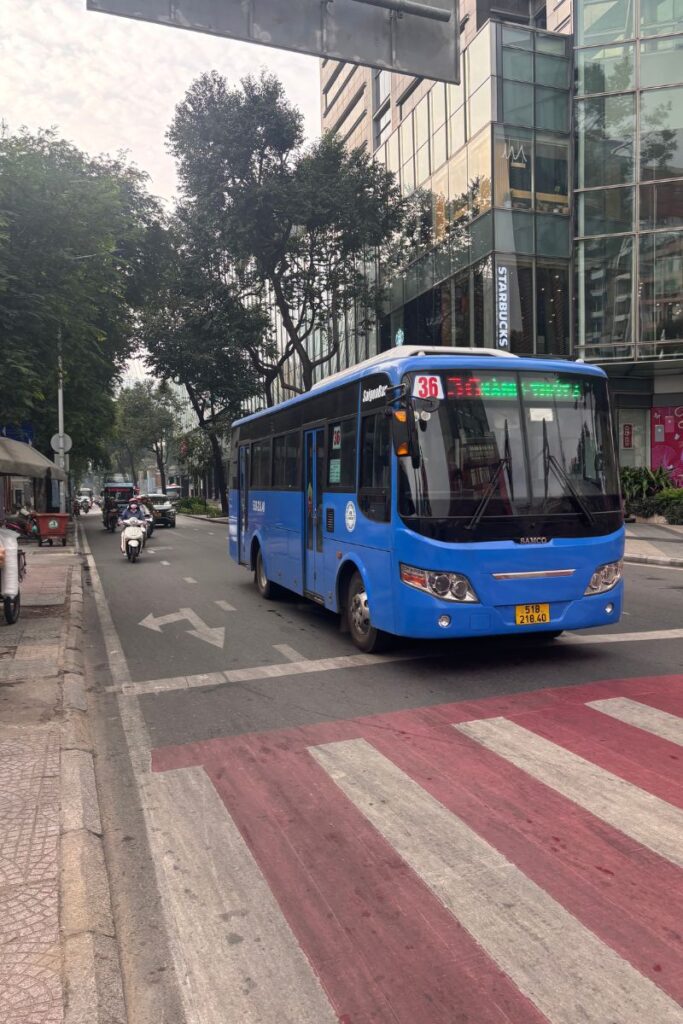
#6. Take buses
City buses aren’t the most practical way to get around Ho Chi Minh City, but there’s a pretty extensive bus system, and you can get almost anywhere by bus. Bus routes run all over the city, to the city’s outskirts, and even out of the city. The city buses are large green and blue buses, but they’ve also been introducing new electric buses with the new metro.
Buses are crazy affordable (less than $0.25 for a ticket), but they can take a long time to get anywhere. I only recommend it if you 1) want just to experience the bus and explore at your own pace, 2) are on a crazy strict budget, or 3) the route you would take only involves one bus and is a straight shot.
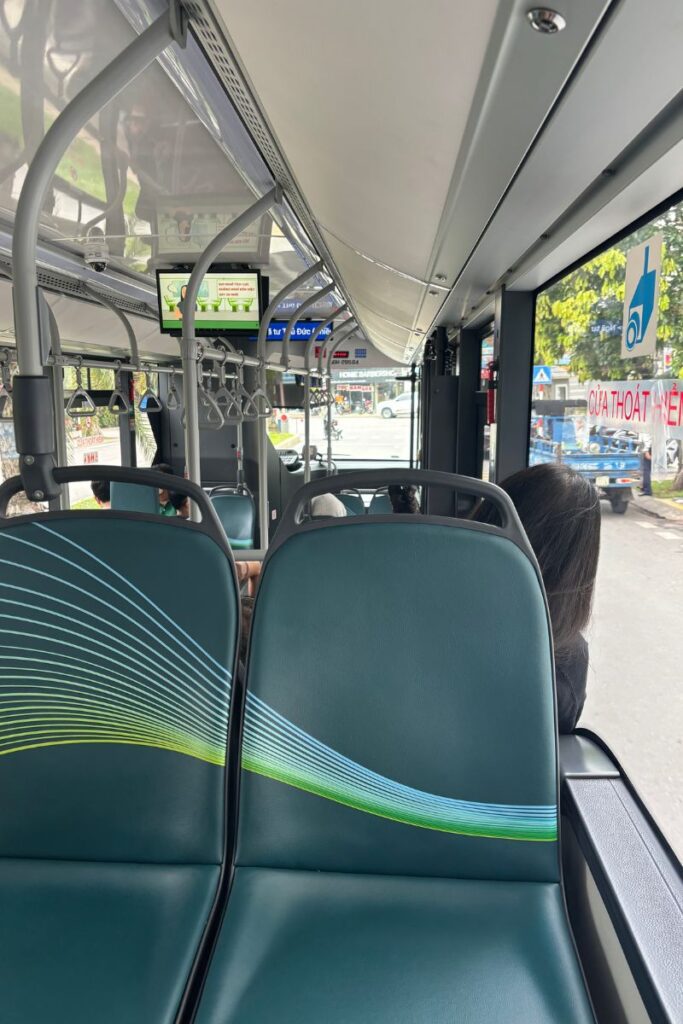
Vin Electric bus (GRP3 and D4)
In addition to the regular city buses, there are also the Vin electric buses (easily recognizable as the big, bright green buses). There are only two routes running: the GRP3 (which is free) and the D4.
We’ve taken both all over the city because we lived in Vinhomes Grand Park, and the GRP3 brought us right downtown. It is comfortable and air-conditioned. They have the same bus stops as the city buses but many fewer stops and makes getting around Ho Chi Minh City pretty easy.
The GRP3, which is free (I’m not sure if it’s free for everyone or only for Vinhomes residents, but they never asked for verification or anything, and my friends took it with me sometimes), goes from D9 Vinhomes to Thao Dien (with several stops in Thu Duc and Thao Dien), Vinhomes Central Park, Vinhomes Center in D1 and a few other stops right downtown.
The easiest place in D1 to get on the GRP3 is at the Vincom Center in D1 (Google Maps Location).
The D4 goes a different route, going past Bui Vien and through the outskirts of the city to D9. Both buses pass by every 15-30 minutes.

How to find the right bus route
Still confused about getting around Ho Chi Minh City by bus? When in doubt, check Google Maps. I’ve found Google to be surprisingly accurate with its bus routes. It only works with the city buses (so not the private bus routes or the longer distance buses, like going to Can Tho).
Overall, it’s pretty spot on. At the very least, it’ll tell you where to get on the bus and where to get off. The timing can be off, but that should be expected in a city like HCMC with all the crazy traffic.

#7. Take the Saigon Water Bus
The Saigon Water Bus is probably the least convenient way to get around Ho Chi Minh City, but it’s still an option. It’s a ferry with only five total stops. It’s not really practical for normal transportation because there are only a few departures each day, but it’s a fun experience if you want to watch the sunset on the river for cheap or something.
The easiest place to get on the ferry is right on the river at Bach Dang Wharf (Google Maps Location).
There are four other stops:
- Binh An (District 2/Thao Dien)
- Thanh Da (Binh Thanh District)
- Hiep Binh Chanh (Thu Duc District)
- Linh Dong (Thu Duc District)
As I mentioned, they aren’t the most practical stops or times, but it’s still fun if you have a free afternoon and want to explore outside the city center.

How We Get Around Ho Chi Minh City
Still wondering how to get around Ho Chi Minh City?
Honestly, it’s best to use all different types of transportation, depending on where you go and what you do. When we go into the city center to do the touristy things, we usually walk everywhere. However, we usually stay outside the city center and having a motorbike is really useful.
There are also a few convenient bus routes, and now that the metro is open, that’s another great option, especially between hotspots like D1 and Thao Dien.
Also, Grab and the other rideshare apps are so affordable it’s another good option.
If you’ve been to HCMC, how did you get around the city? If you haven’t, would you feel comfortable driving or calling a Grab?



Leave a Reply