

Do you want to visit Vietnam’s famed Cu Chi Tunnels?
If so, you’re in luck! We enjoyed a fantastic excursion from our home base in Ho Chi Minh City to the Cu Chi Tunnels, and we’re here to share everything we learned with you.
So, get ready to experience a little bit of history, culture, and nature, along with a dash of adventure on your epic Cu Chi Tunnels trip!

What Are The Cu Chi Tunnels?
Cu Chi Tunnels (Ben Duoc) is a historical landmark in Ho Chi Minh City’s Cu Chi district, a semi-rural area about 55 km (34.2 miles) from downtown Saigon.
The elaborate system of hand-dug tunnels spans hundreds of kilometers and once served as the base of operations for the Viet Minh, aka “The National Liberation Front” or “Viet Cong,” in their resistance against the French and Americans.
Initially constructed by local villagers in the 1940s, the tunnels were expanded in the 1960s during the war against the Americans. They became part of a more extensive spider-web-like tunnel network that concealed troop movements, protected soldiers from enemy fire, and provided living quarters in much of the countryside around Saigon.
Today, the Vietnamese government maintains the tunnels, which have become a popular tourist destination and day trip for visitors to Ho Chi Minh City. Most travelers visit the site at Ben Dinh. However, we visited Ben Duoc, a larger and more authentic site that’s less touristy than Ben Dinh.

What Can You Do At Cu Chi Tunnels?
You may be surprised to learn there’s more to the Cu Chi Tunnels than simply tunnels. So, if you’re not down with crawling on your hands and knees through small, dark spaces, you may be happy to hear that the site also serves as a quasi-museum and features some exciting activities for thrill seekers.
So what exactly can you do there?
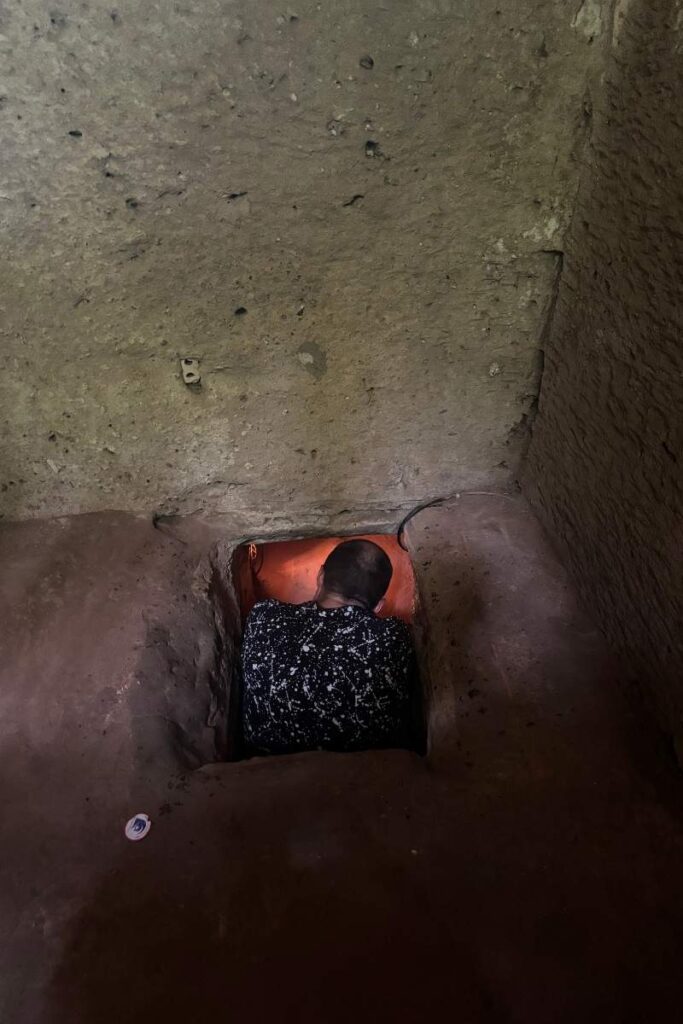
1. Crawl Or “Duck Walk” Through The Tunnels
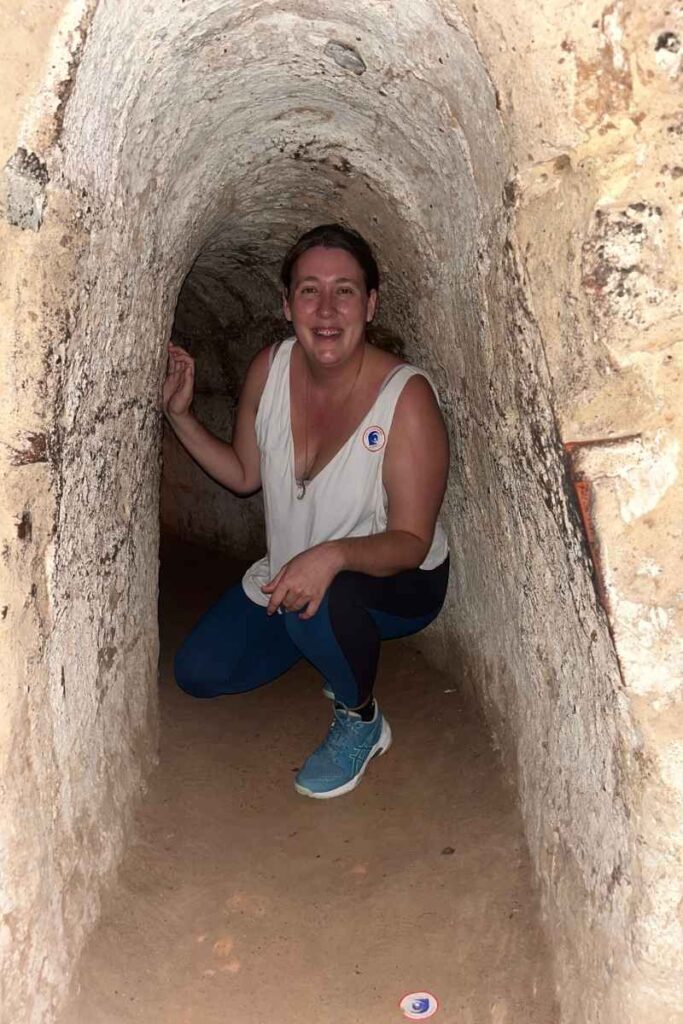
While some of the Cu Chi Tunnels have been enlarged since the Vietnam War or the American War (as it’s known here), most are still quite snug.
That said, most people should be able to “duck walk” or crouch and walk through many of the Cu Chi Tunnels. The entryways have stairs wide enough for an average-sized person to fit through. But you will have to duck your head to enter the cave!
I’m about 178 cm (5 feet 10 inches) tall and weigh about 82 kg (180 pounds), and I had no problem getting into or walking through the tunnels. However, I had to crouch relatively low and felt a burning sensation in my leg muscles as I scampered my way from one side to the other.
I’m also relatively claustrophobic and tend to do poorly in confined spaces, but the tunnels didn’t cause me much if any, anxiety. Sure, it can get pretty stuffy down there on a hot day, yet most tunnel runs are short and can be moved through in just a minute or two.
However, one infamous stretch of the Cu Chi Tunnels, a 150 m (492 foot) enclosure, takes several minutes to pass through. Of course, you can always skip this section (as we did), but if you do, go, prepare to be down there a little longer, and be ready to get a workout!
2. Touch Real War Artifacts
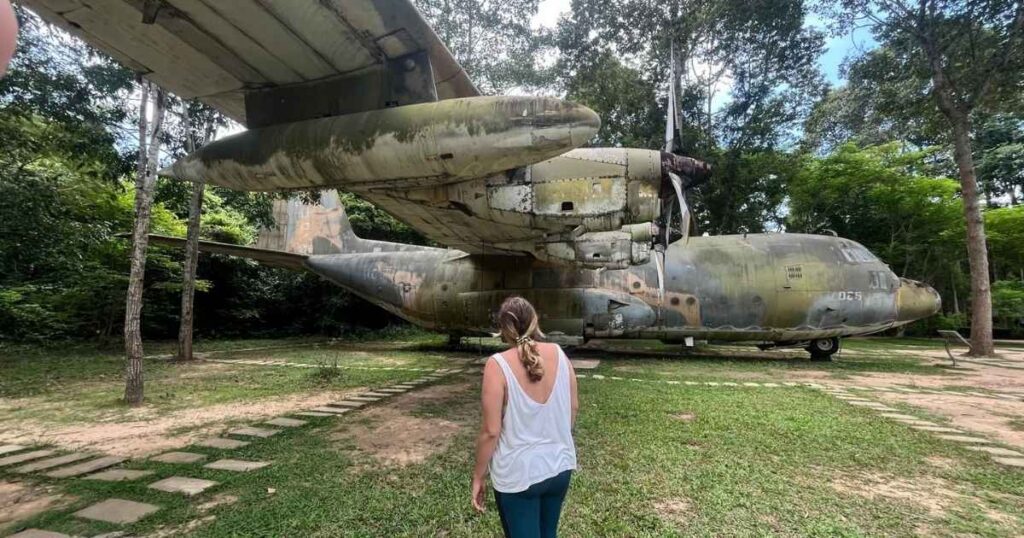
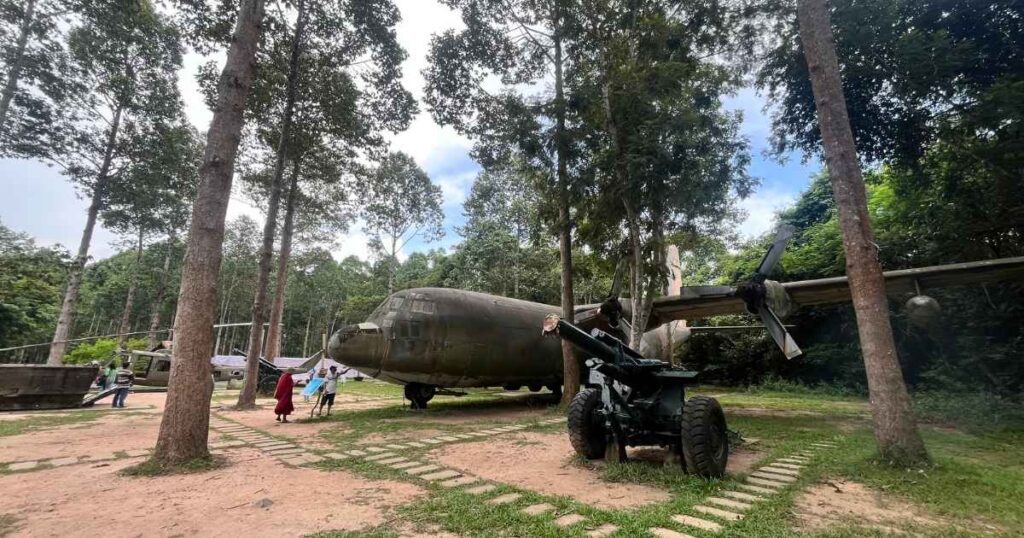
Relics of the tragic wars of yesteryear are scattered all around the Cu Chi Tunnels.
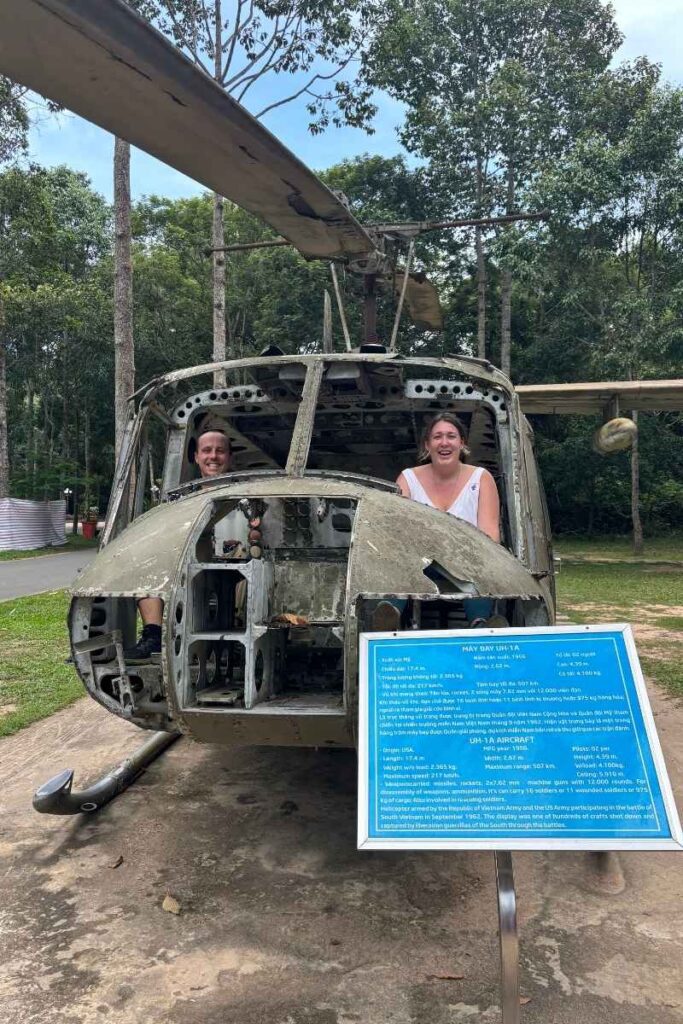
Many battle artifacts, including helicopters, airplanes, and decommissioned bombs, can be seen, touched, or even sat in. This provides history buffs like me with unparalleled access to the tools used to prosecute the horrors of the Vietnam War.
Specific artifacts at Cu Chi Tunnels include a C-130 “Hercules” Transport Plane, which the Americans used to deliver troops and drop supplies into combat zones, as well as a UH-1 Iroquois or “Huey” helicopter (used by South Vietnamese or ARVN forces), which has become symbolic of the Vietnam War.
In addition to those aircraft, you’ll find an array of guns, artillery, bombs, mortars, and other weapons and ammunition used by the North Vietnamese Army, Vietn Minh fighters, the South Vietnamese Army, and the Americans. However, unlike the bigger artifacts, most smaller weapons are enclosed in glass cases.
Of course, seeing all of these things in one place can stir up feelings of anger, sadness, and resentment. However, we must study history to learn from our mistakes and avoid them in the future. Cu Chi Tunnels offers an up-close experience with the follies of the American War in Vietnam.

3. Get A Feel For Life In The Tunnels
When you first see the Cu Chi Tunnels, you may ask yourself, “How the heck did people live down here?”
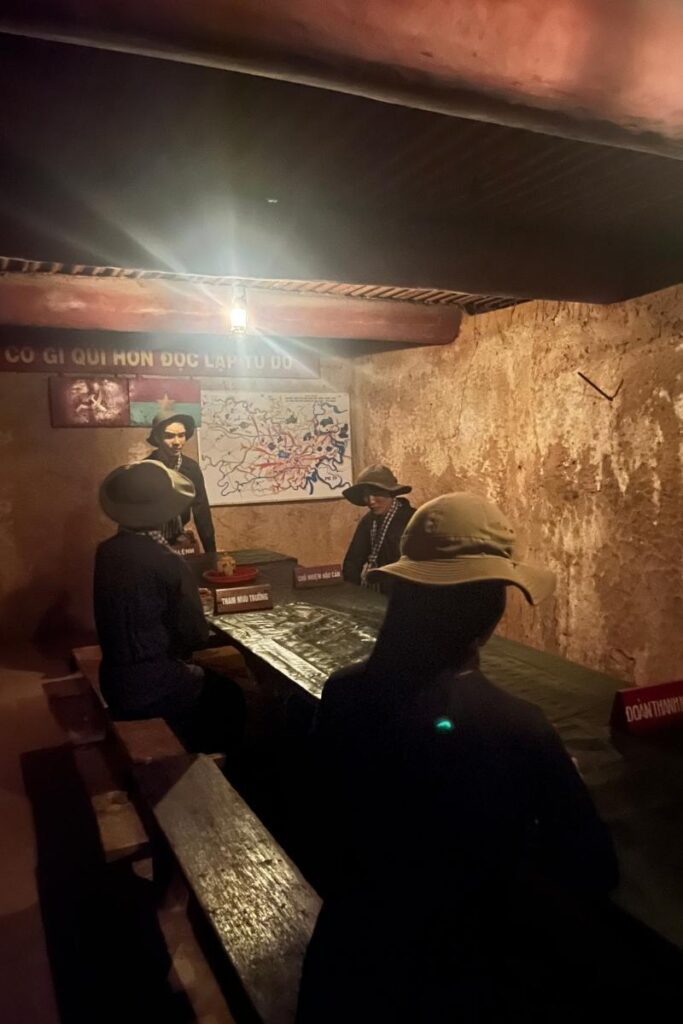
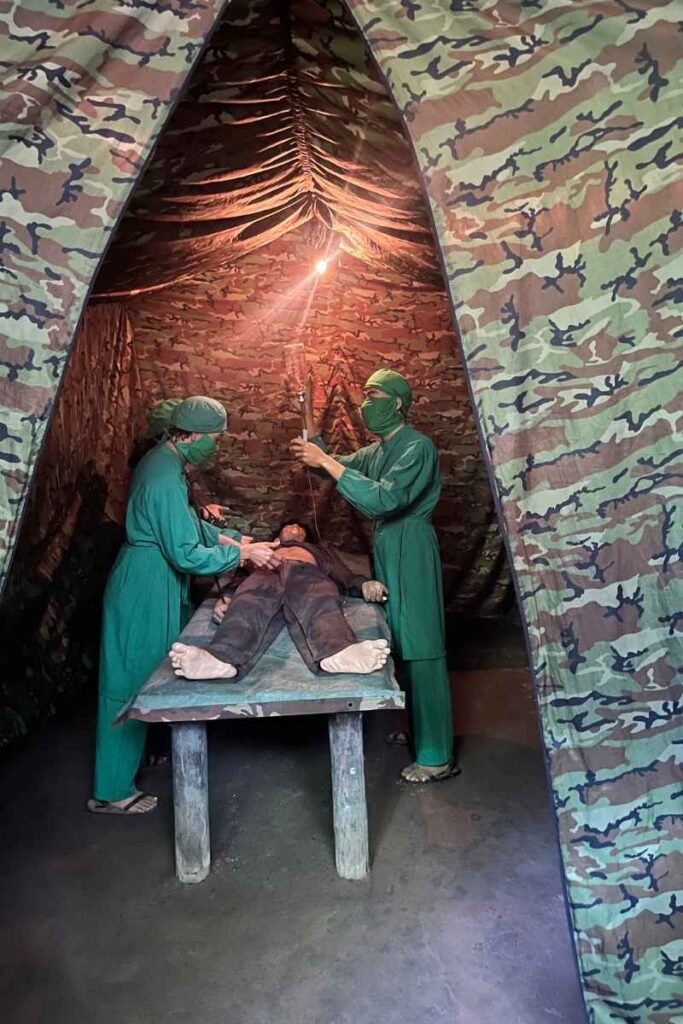
The site’s curators attempted to answer that question by setting up wax figures accompanied by furniture and other props that vividly depict wartime life underground.
In one room, you’ll find a mock command center complete with maps of battlefields, signs with political slogans, Viet Minh and communist flags, a long table where strategy was planned, and figures dressed in the traditional black clothing and black and white scarfs worn by members of the National Liberation Front.
Another room shows you bunks where fighters would have slept, and yet another, a table where they would have taken their meals. Still, another room, which served as a hospital and operating theater, offers you a look at the dire conditions doctors were forced to work under to save the lives of wounded soldiers.
Lastly, there is a separate section where you can see how the Viet Minh deconstructed American mines, bombs, and other ordinances to build explosives of their own. Though somewhat unnerving, using mannequins and other proper brings the whole experience to life!
4. View Recreations Of Viet Minh “Booby Traps”
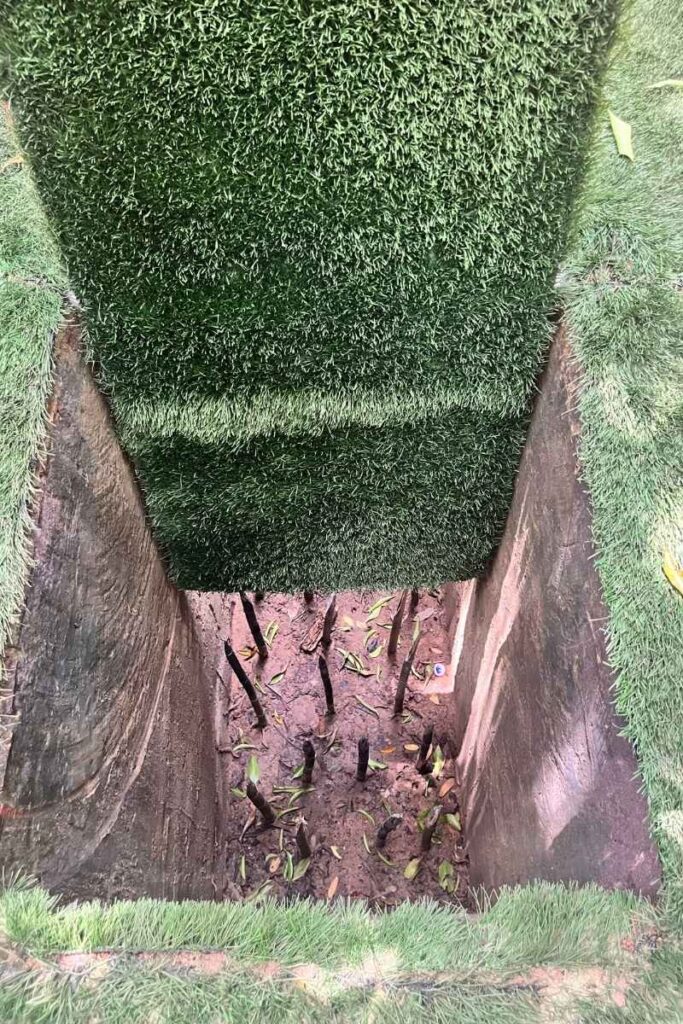
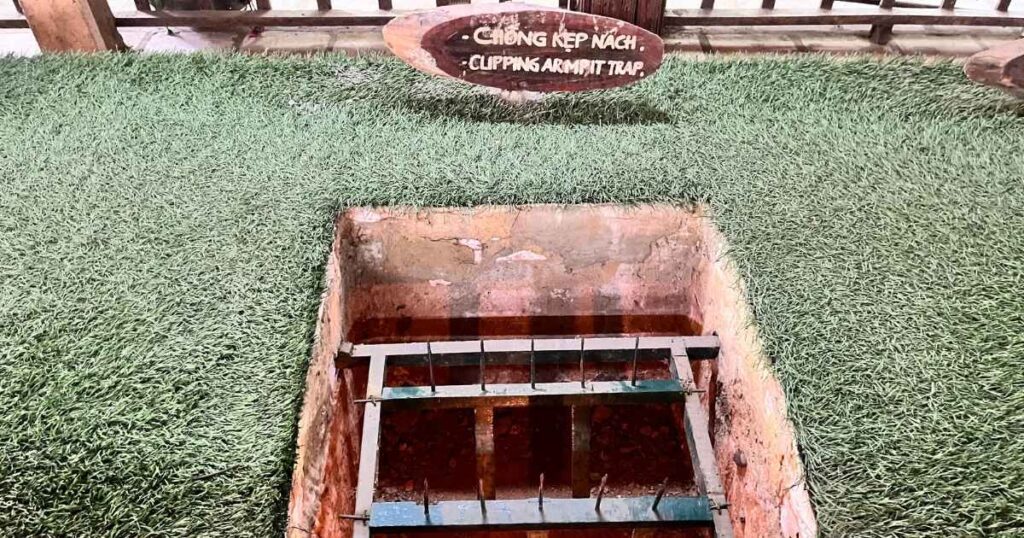
One of the most famous aspects of the Cu Chi Tunnels is its exhibition featuring various “booby traps” designed, built, and used by the Viet Minh.
You may have seen famed Vietnam War movies like Platoon or The Deer Hunter, which graphically depict the ingenious but deadly traps constructed by the Vietnamese liberation forces. However, here you’ll see them up close and personal.
This site section is under a thatched roof near the gift shop and exit. It’s a harrowing way to end your journey through the Cu Chi Tunnels. Upon entering the area, you’re immediately struck by the mural painted on the wall depicting American soldiers walking through the jungle. Then you notice the “booby traps.”
Each device is equipped with a sign describing it. Names like “rolling trap,” “fish trap,” and “clipping armpit trap” give you an idea of how these rudimentary death machines were designed to work. While it may be uncomfortable to think about, this section of the Cu Chi Tunnels contextualizes how the war was fought.
I felt myself thinking about how I would have felt traipsing through the jungle, knowing that not only could I get shot, but I could step on one of these traps and be horribly maimed or killed. It reminded me exactly what the young kids who served here went through, whether they wanted to or not.
5. Fire The Weapon Of Your Choosing
A more polarizing part of the Cu Chi Tunnels is its sizeable outdoor firing range, where you can shoot various guns.
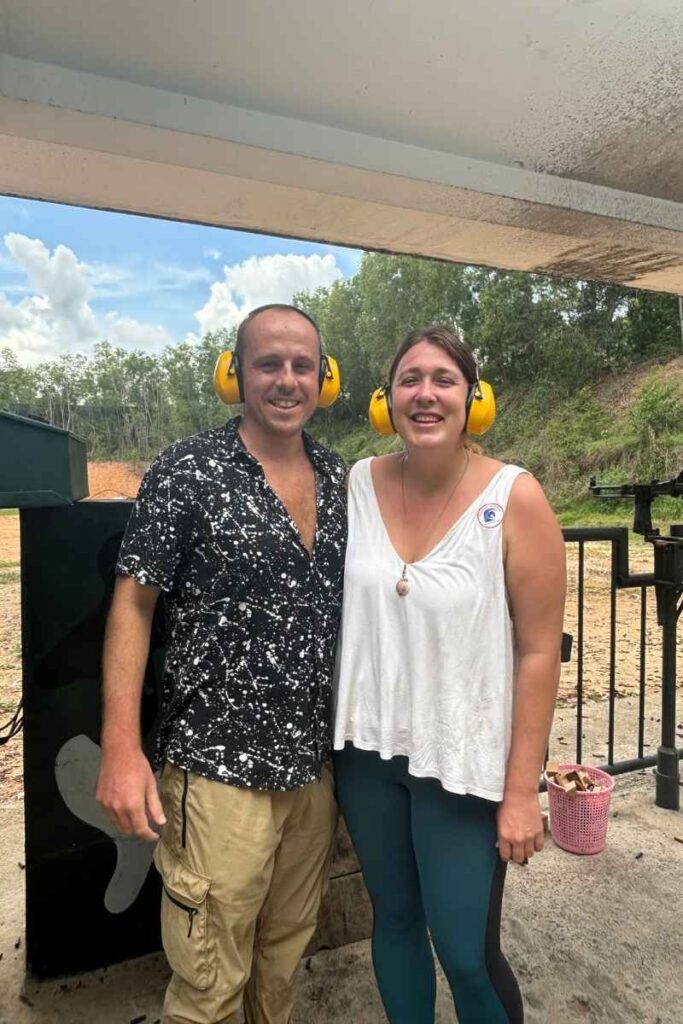
While I am not an advocate of firearms, I couldn’t pass up the opportunity to take a few shots down range. I opted to use the AK-47, which was the weapon of choice for the Viet Minh forces, who once called these tunnels home.
I purchased my ticket near the front entrance and was whisked away in a golf cart by a woman and her small child. We set out down a gravel road that ran behind the war artifacts section of Cu Chi Tunnels. After about 5 minutes, we arrived at the shooting range, where a few young men in uniform greeted me.
They looked at my ticket and laughed when they saw that I had purchased just 5 bullets for an AK-47. They charged about 20,000 VND (0.78 USD) per bullet, but what can I say? I’m not exactly a big spender, and I thought 5 bullets would be enough to get an idea of how firing an AK-47 felt.
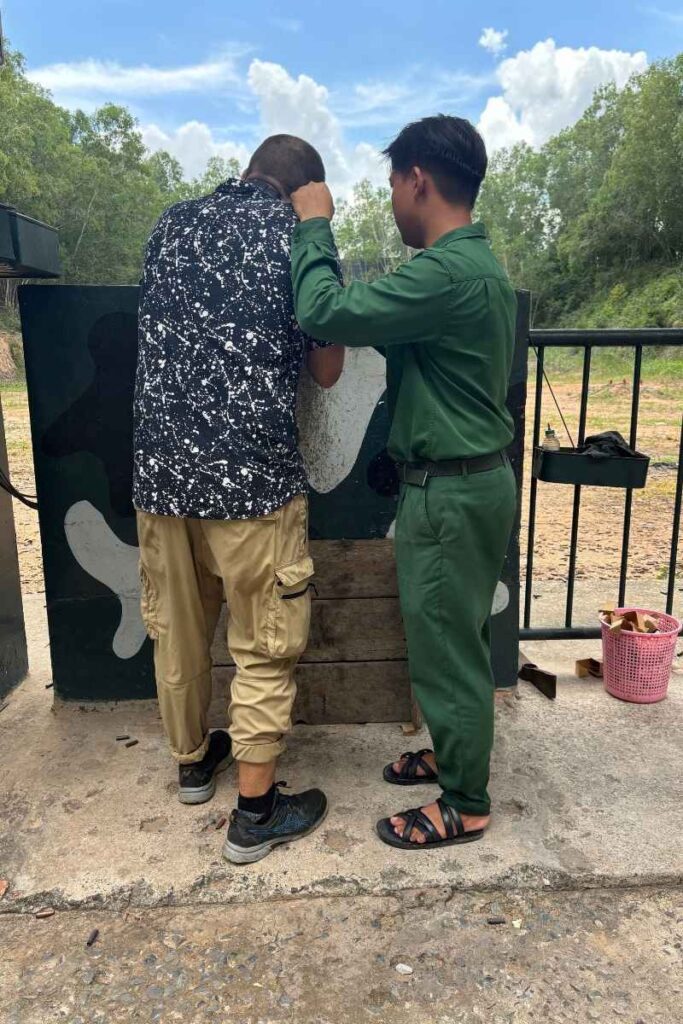
One of the young men working there set me up and let me know I was ready to fire away. The gun was attached to a mount for safety reasons, so I couldn’t pick it up and aim it anywhere other than down range. They also gave me some ear protection. I fired my five bullets, hitting the target once or twice, and that was it. We hopped back on the golf cart and returned to the front of the site.
How to get to Cu Chi Tunnels
Cu Chi Tunnels is one of our favorite day trips from Ho Chi Minh City.
It may be most convenient to book a tour of the Cu Chi Tunnels. We recommend this private tour, as it allows you to choose between visiting Ben Duoc or Ben Dinh. This speedboat tour from Saigon to Cu Chi Tunnels is also great.
If you opt to take a tour, we recommend choosing one that only goes to the Cu Chi Tunnels. Some tour packages advertise a one-day tour of the Mekong Delta and Cu Chi Tunnels. However, the Mekong Delta is massive and far from Ho Chi Minh City. Exploring the Mekong Delta and Cu Chi Tunnels in one day is impossible and probably isn’t worth trying.
Other ways to get to Cu Chi Tunnels include:
- By Bus: The most affordable way to Cu Chi Tunnels is to take a bus, but it is also the most time-consuming, as it takes about 2.5 hours each way. You’ll want to take bus #13 from 23-9 Park (near Pham Ngu Lao Street). This will drop you off at Cu Chi Bust Station. You’ll get on bus #79 to the Cu Chi Tunnel site at Ben Duoc or bus #63 to the Ben Dinh site.
- ByTaxi: It’s possible, though probably somewhat expensive, to take a taxi from Ho Chi Min City to Cu Chi Tunnels, but if you want to take this route, we recommend using a ride-hailing app like Grad or Xanh SM.
- By Boat: Like the recommended tour above, Boat services can take you to the Cu Chi Tunnels. Most leave from Tan Cang Pier, also known as Saigon River Pier.
- By Motorbike: Cu Chi Tunnels is only a couple of hours’ drive from Saigon by motorbike. However, the roads are somewhat busy with trucks, so we wouldn’t recommend it unless you’re experienced.
We drove our motorbike from District 9 in HCMC to Cu Chi Tunnels. We moved at a leisurely pace and even stopped for food at one point, and it still took us only about 2.5 hours each way. If you drive a motorbike, we recommend leaving Saigon early in the morning and returning early in the afternoon to avoid peak rush hour traffic. If you want an inside scoop on driving in and around Saigon, check out our Tips For Driving In Ho Chi Minh City.

How much does it cost To Visit Cu Chi Tunnels?
Admission to Cu Chi Tunnels (Ben Duoc) is 35,000 VND ($1.37) per person, and hiring a guide costs 90,000 VND ($3.51) per person. Of course, prices can increase with time, but these were the going rates when we visited Cu Chi Tunnels.
Tours that provide transportation, a guide, food, drinks, and access to Cu Chi Tunnels start as low as 500,000 VND ($19.50) per person for group tours. To weigh your options, you can check out group and private tours on Viator or Get Your Guide.
When Should You Visit Cu Chi Tunnels?
Visiting Cu Chi Tunnels during Southern Vietnam’s dry season (December – April) is best. As you might expect, you’re more likely to have dry conditions during these months. You’ll also avoid the intense humidity and scorching temperatures of the rainy season (May-November).
Of course, the weather in Vietnam is subject to change, and if you’re visiting during the rainy season and want to see the Cu Chi Tunnels, you can still do it. Most days during the rainy season, you’ll typically get short bursts (1-2 hours) of intense rain, usually in the late afternoon or evening.
For more information on the weather in southern Vietnam, see our article on the Best Time To Visit Ho Chi Minh City (Month-By-Month Guide).
Is It Worth Visiting Cu Chi Tunnels?
Many Ho Chi Minh City visitors may not know about the Cu Chi Tunnels. However, we say they’re worth visiting, especially the site at Ben Duoc!
The unique tunnel complex offers visitors a chance to see first-hand what life was like for the men, women, and children who suffered under foreign occupation by both the French and Americans. You can see how the brave Viet Minh fighters lived daily and gain insight into the weapons and tactics they used to win their independence.
I’ve been to many war sites, including famed battlefields like Khe Sanh and and Dien Bien Phu, and Cu Chi Tunnels was perhaps the best in terms of its representation and sheer number of artifacts. I returned from my trip here feeling like I had a much better understanding of the Viet Minh’s ingeniousness and the perils that French and American forces dealt with.
A trip to Cu Chi Tunnels is an excellent way to spend a day in Saigon. Not only will you learn a little history, but you’ll also get a chance to see some local areas outside of the city and get a taste of the beautiful nature in Southern Vietnam since the tunnel site is surrounded by the dense jungle so prevalent in this part of the country.
Want to find more things to do while you’re in Ho Chi Minh City? Check out our blogs on the 27 Best Things To Do In Ho Chi Minh City.
Final Thoughts On Visiting Cu Chi Tunnels
Still on the fence about visiting Cu Chi Tunnels?
I may be biased since I have become somewhat obsessed with the history of Vietnam, particularly the 19th and 20th centuries, but visiting Cu Chi Tunnels was easily one of my best days in Vietnam. I learned a lot about the Vietnamese resistance against the French and the Americans and got the hands-on experience you don’t get in your average museum.
Would I do it again?
Yes absolutely!
Looking for more things to do while you’re in Southern Vietnam?
Read our in-depth guide on How To Visit Monkey Island and The Ultimate Guide To Visiting Cat Tien National Park From Ho Chi Minh.



Leave a Reply