
Are you considering traveling to Vietnam during the Tet holiday?
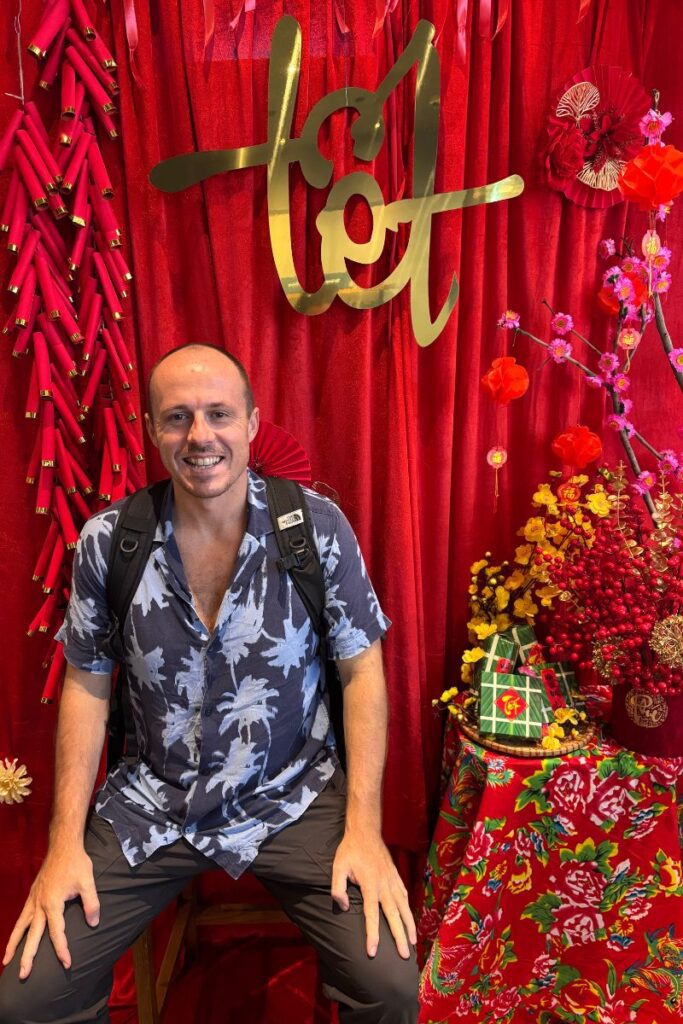
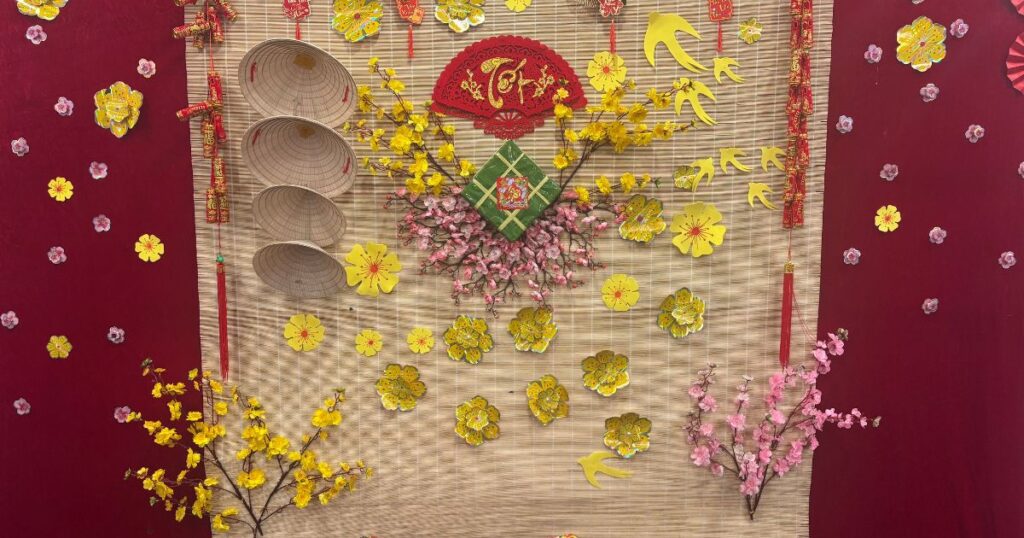
The first signs you’ll have of Tet in Vietnam will be the vibrant red and gold banners adorning doorways, walls, and overhangs, the blossoming marigolds, chrysanthemums, and kumquat trees placed in foyers, lobbies, and living rooms, and a generally festive atmosphere pervading the streets, parks, and shops.
However, if you’re planning to celebrate the Tet holiday in Vietnam, there’s a lot you should know because the jubilant festivities can make day-to-day travel a little more complicated than usual.
The good news is that we’ve spent multiple Tet holidays bouncing around Vietnam’s big cities, coastal villages, and mountain towns, learning to deal with service slowdowns (and other changes that come with this magical time of the year). Now, we’re here to share all our insider travel tips with you.
So, strap in, enjoy a sticky rice cake (a traditional Vietnamese Tet snack), and prepare for Vietnam’s biggest holiday!

What Is Tet & How Is It Celebrated?
Tet is the annual Vietnamese celebration of the Lunar New Year and the country’s most sacred traditional holiday.
It typically falls in late January or early February, and while it only officially lasts three days (officially), there’s often as much as a week or even two of revelry.
The Vietnamese people see Tet as a time for new beginnings. Everyone wants to start the new year out on the right foot, and traditional beliefs suggest that the first day or two will indicate how one’s next trip around the sun will go. Falling off your bike or arguing with your spouse could be bad omens. Receiving a kind smile from a stranger or enjoying a delicious meal with loved ones could be the gateway to a healthy and prosperous year.
But how do locals celebrate Tet?

1. Cleaning & Decorating Homes
Before the new year strikes, Vietnamese homes undergo a deep clean to remove all the past year’s clutter, dust, and dirt. This symbolizes a fresh start to the year, like a “spring cleaning.” Then Vietnamese homes are often decorated with red and gold ornaments, festive plants, and flowers that signify prosperity, growth, and vitality.
2. Reuniting With Family
Tet is mostly about getting together with family, honoring elders and ancestors, and reconnecting to one’s roots. Many Vietnamese who have moved to cities like Hanoi, Ho Chi Minh City, or Da Nang return to their hometowns to spend quality time with their parents, grandparents, brothers, sisters, aunts, uncles, and cousins.
3. Eating Traditional Foods
Tet is a great time to enjoy Vietnam’s rich tapestry of culinary options. Traditionally, during Tet, locals like to eat sticky rice cakes (bánh chưng & bánh tét), braised pork belly with eggs (thịt kho tàu), pork sausages (giò chả), pickled onions (dưa hành), bitter melon soup (canh khổ qua), red sticky rice (xôi gấc), fried spring rolls (chả giò) and lots of fruit and seeds.
4. Giving Lucky Money
Giving lucky money is a time-honored tradition during Tet in Vietnam. Older family members provide lucky money to children, married adults give lucky money to their parents and grandparents, and some employers may offer lucky money to employees. Lucky money is also given to respected teachers and service workers, such as housekeepers or security guards. It’s typically delivered in red envelopes, which symbolize good fortune.
5. Providing Offerings
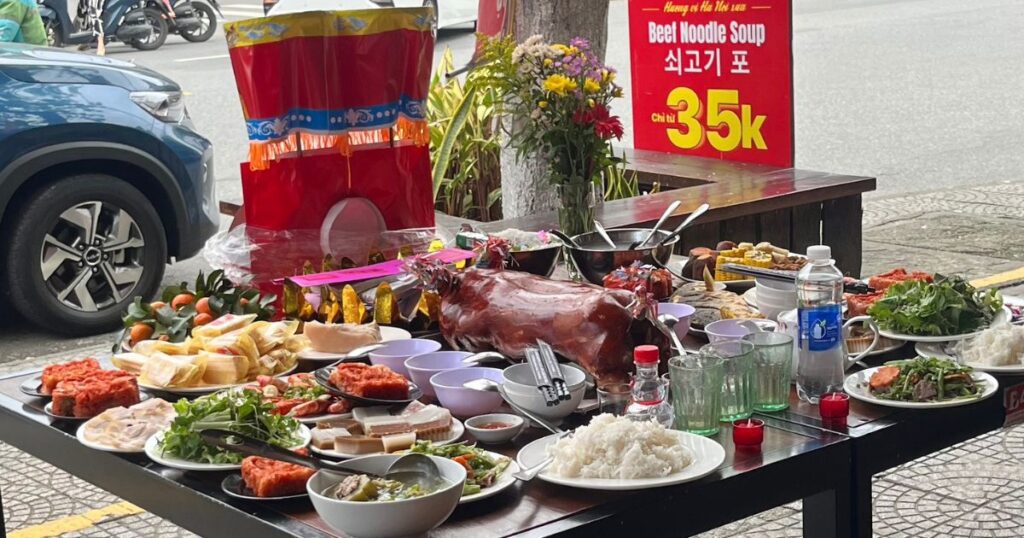
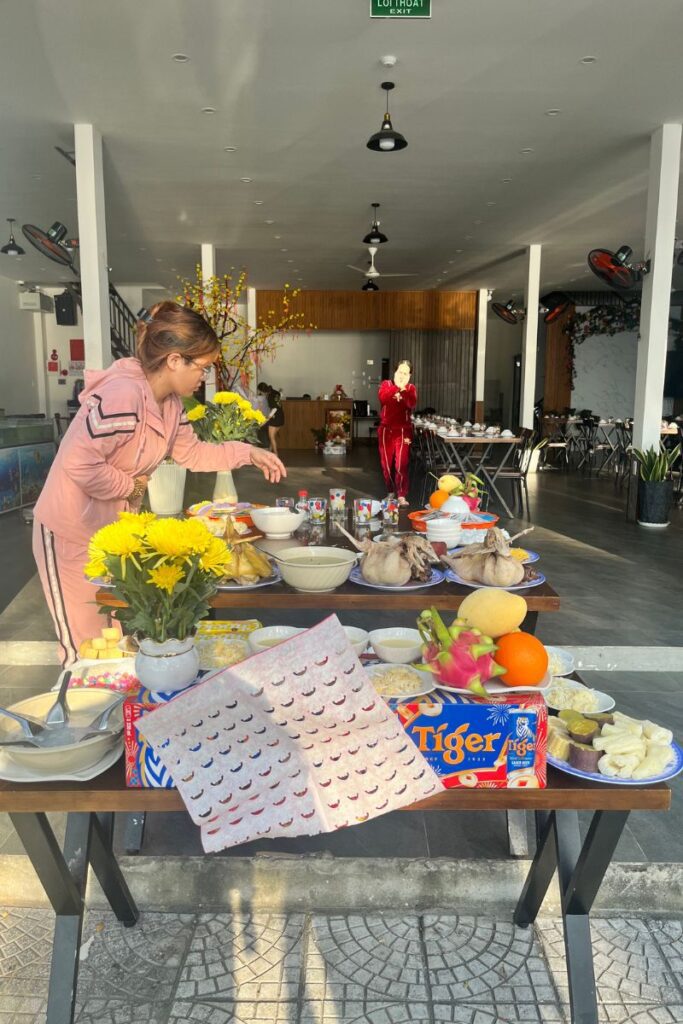
It’s common to see tables full of food and beverages, including chicken, pork, cakes, cookies, chips/crisps, wine, beer, soda, and other delights on the side of the road and within homes during the Tet season. Typically, these offerings consist of ancestors’ favorite treats meant to entice these ancestors to return from the spiritual realm and spend Tet with their family here on Earth.
What To Expect Before Tet In Vietnam
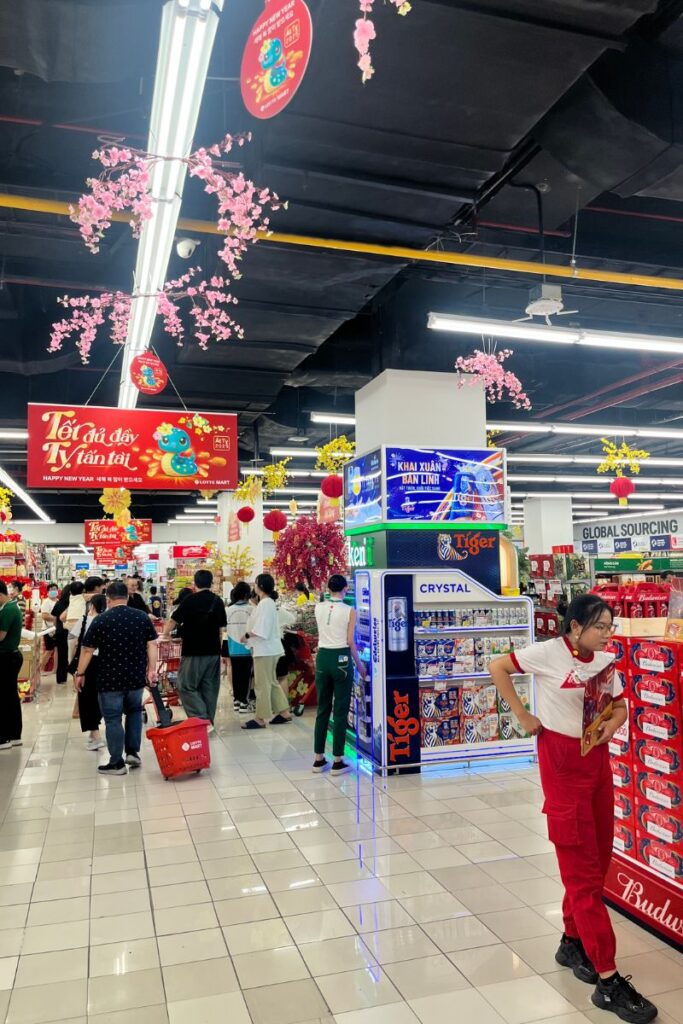
The weeks leading up to Tet are affectionately known as the “Tet Rush.” During this busy time, there’s electricity in the air as decorations are going up, many folks are returning to their hometowns, and everybody is excited to start the new year in style.
Road traffic may pick up slightly, markets fill with eager shoppers, and malls can become chaotic. Vietnamese workers often receive a Tet bonus (thưởng Tết), which creates an instant buyer’s market. It’s customary for people to stock up on snacks, drinks, and gifts before they go home to see loved ones for the holiday.
So, what does that mean for you?
Only that you should expect the crowds to grow, lines to lengthen, and, in some places, prices to increase. That said, the weeks before Tet are the time to stock up on groceries if you’re hunkering down in one place. We generally run to the supermarket to get the essentials (eggs, water, coffee, fruit, veggies, and canned goods) because, as you’ll see, many businesses close during the three primary days of Tet, if not longer.
What To Expect During Tet In Vietnam
The first three days of the Lunar New Year are the most active days for celebrating Tet. Think of the first day of the Lunar Calendar as “New Year’s Day.” That day and the following two days are when Tet is most enthusiastically celebrated.
However, as the clock strikes midnight on the first day of Tet (think the ball dropping on New Year’s Eve), tourist hotspots like Da Nang, Hoi An, Hue, Hanoi, and Ho Chi Minh City will have fireworks and other festivities. That evening functions similarly to a Western New Year’s Eve.
Other than that, what exactly should you expect during Tet in Vietnam?
Businesses Close Their Doors
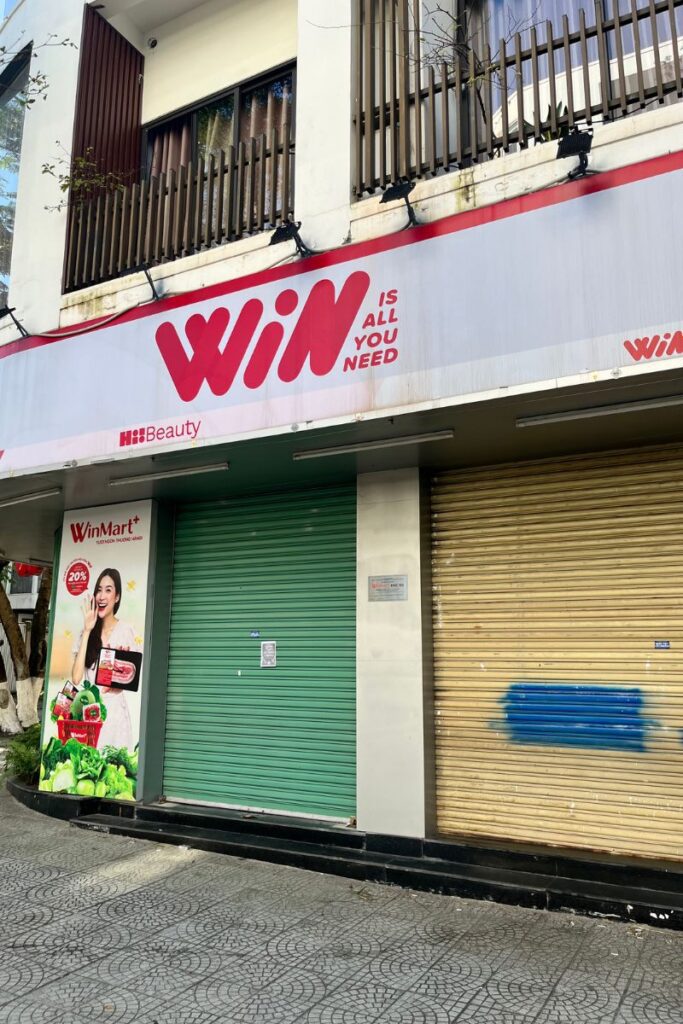
Businesses will close during Tet. Even the most popular restaurants, biggest markets, and swankiest shopping malls will probably close for at least one day (the first day of Tet). However, many family-run shops may be closed for three to seven days. That’s why it’s essential to get what you need beforehand. Of course, if you’re staying in a tourist area such as District 1 in Ho Chi Minh City or The Old Quarter in Hanoi, you’ll find some restaurants and convenience stores open.
Insider Tip – Expect things to be shut down. There’s no precise rhyme or reason for which businesses will close and for how long. So, we prepare as if our favorite restaurants, markets, motorbike mechanics, and other go-to spots will be unavailable for at least a few days.
Restaurants Add The Tet Surcharge (phụ thu Tết)
The restaurants that stay open will be more expensive. That’s because they add a Tet surcharge (phụ thu Tết), which may leave a bad taste in some travelers’ mouths—however, this is standard practice throughout Vietnam. It’s not a scam. You see, the law stipulates that employers have to pay employees more during the Tet holiday. Therefore, the employers pass that cost along to us. The surcharge is usually 10%, though it could be as high as 20%.
Insider Tip: If you’re eating out, bring a little extra cash with you. During Tet, everyone wants to celebrate with family; if they’re working, they deserve to make an extra buck or two. That’s why we’re fine paying the added service fee. Also, generally speaking, the “fancier” the restaurant, the higher the Tet surcharge.

Transport Is Tough To Come By & More Expensive
Buses, trains, planes, taxis, and, well, all forms of transport become far less available during the Tet holiday in Vietnam. This is due to fewer people working and more people needing transport back home. So, if you’re planning to travel between cities in Vietnam during Tet, our advice would probably be don’t. But, if you have to, try to book your tickets early because they will sell out faster than you can say, rice cake!
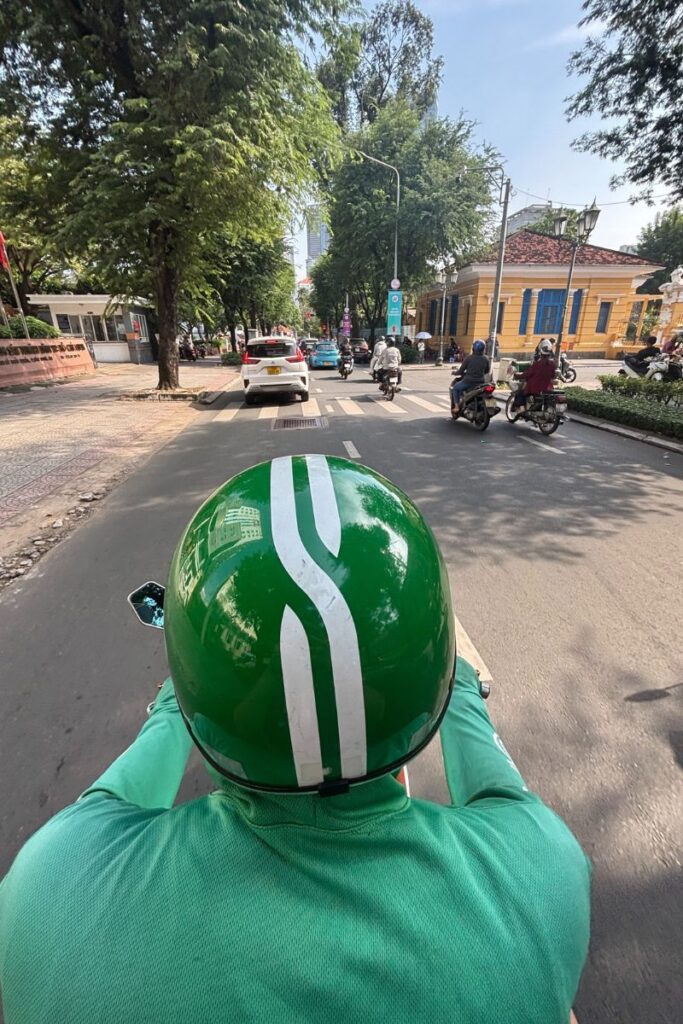
Insider Tip – Avoid traveling long distances during the three primary days of Tet. If you must, book your trip as early as possible. If it’s last minute, expect everything to be less convenient than any other time of the year. If you’re just taking a Grab bike, rideshare car, or taxi, it might take longer to find a driver, so plan accordingly. Leave earlier and embrace delays. The journey, not the destination, is the experience… or something like that!
Big Cities Empty Out
When you think of Vietnam, you might imagine the chaotic streets of Ho Chi Minh City or Hanoi, full of motorbikes zipping about, vendors selling food, clothes, and trinkets, and foreigners struggling to find some way, any way, to cross the road. However, during Tet, the big cities in Vietnam can become eerily quiet. As we mentioned, many Vietnamese escape the hustle and bustle of city life to spend time in ancestral lands, typically small villages scattered about the countryside, during Tet.
Insider Tip: You may notice a considerable decrease in people around Vietnam’s metropolises over the Tet holiday. Enjoy the extra space on the sidewalk and the ease with which you can now cross the roads previously teeming with traffic. There should also be less smog (air pollution), so that’s a bonus!

Public Services Are Limited
Government offices, banks, schools, and even hospitals may close or only offer limited services during Tet. ATMs may run out of cash, as they likely won’t be serviced for at least three days. Seeing a doctor (barring an emergency) might be nearly impossible. Having your visa renewed or doing a visa run over international borders, such as Moc Bai (the popular land border between Cambodia and Vietnam), could be challenging.
Insider Tip – Pull out enough cash to last you about a week before the first day of Tet. See your doctor or stock up on medicine before the festivities begin if you have medical concerns. If you must renew your visa, do so well before Tet begins.
Where Are The Best Places To Experience Tet In Vietnam?
So, you’re ready to celebrate Tet in Vietnam, but where should you go?
Where can you have the most fun, experience the best cultural value, eat the tastiest food, see the prettiest fireworks, or enjoy the wildest party?
We’ve got you covered, no matter what you’re looking for.
Ho Chi Minh City
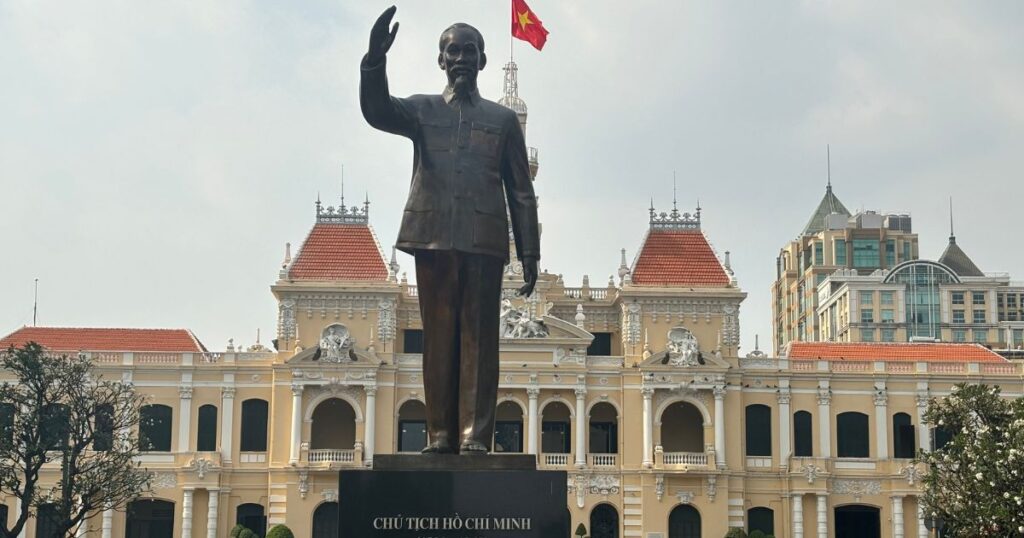
Despite the large swaths of the city feeling like a ghost town, the downtown area of Ho Chi Minh City is bursting with pure energy amid the Tet holiday in HCMC.
During the Lunar New Year countdown, you can view fireworks and celebratory light shows from the observation decks at Landmark 81, Bitexco Tower, or one of the many sky bars around District 1. Want to view the show from somewhere more low-key? Head to the Bach Dang Wharf, along the Saigon River (Sông Sài Gòn), where you’ll get a great (and free) view.
Check out Nguyen Hue Street, adjacent to the Bach Dang Wharf, which is transformed into a Tet cultural exhibition full of decorations, fun, and excitement during the holiday. Thousands of Vietnamese and foreign tourists descend on this famous boulevard to admire its beauty and splendor, which has come to symbolize Saigon.
If you feel like having a party, take a look at Bui Vien Street, where the fiestas continue every night right through Tet. Grab a cold beverage with friends, settle into a small plastic chair and watch the crowds go by, or hit the dance club and tear it up until the break of dawn!
Insider Tip: While it’s true that sections of Ho Chi Minh City completely clear out during Tet, it’s still the most energetic Tet celebration in the country. If you’d like to learn more about visiting the city formerly known as Saigon during other parts of the year, read Best Time To Visit Ho Chi Minh City (Month-by-Month Guide) for more information about seasons and festivals in the region.
Hanoi
As you might expect, much of Hanoi is largely deserted during the primary days of the Tet festival. However, being Vietnam’s capital city and cultural center, Hanoi offers the perfect blend of traditional and modern Tet festivities.
On the night before the first day of Tet (New Year’s Eve), you can watch fireworks illuminate the night sky over the iconic West Lake (Hồ Tây) or Hoan Kiem Lake (Hồ Hoàn Kiếm), both popular with midnight revelers out to ring in the new year in style.
Feast your eyes on the colorful Tet-centric flower markets in the Old Quarter, Hang Luoc Street, or the famous Quang Ba Flower Market in Tay Ho District. Traditional Tet floral arrangements, including peach blossoms and kumquat trees (common in the north), can be seen in these places.
If you’d like to get a taste of how locals celebrate Tet in Hanoi, visit the Temple of Literature (Văn Miếu) or Quan Thanh Temple (near the West Lake), where you’ll find worshippers praying for wisdom, success, and good fortune in the coming year. If you go, be sure to respect local customs. Wear appropriate clothing (cover shoulders and legs), remove your shoes inside, and keep your voice to a minimum when people are worshipping.
Insider Tip: Hanoi is an excellent option for seeing how Tet is celebrated today and how it may have been celebrated five hundred years ago. In essence, it offers the best of both worlds. However, it’s worth noting that much of the city may shut down (more so than Ho Chi Minh City) during the primary days of Tet.

Hoi An
In recent years, Hoi An has become a hotspot for travelers to Vietnam during Tet and year-round. A UNESCO World Cultural Heritage site, Hoi An is a pristine showcase of ancient Vietnamese culture.
On the eve of the Lunar New Year, Hoi An’s famous Old Town comes alive with traditional folk music, shops selling traditional Vietnamese foods, and a beautiful midnight fireworks show over the Thu Bon River (Sông Thu Bồn).
Look around, and you’ll see a variety of celebrations, including lion dances and calligraphy sessions, as well as Bài Chòi, a centuries-old Vietnamese practice that combines a bingo-like card game intertwined with rhythmic singing and musical instruments.
But the most unique feature of Tet in Hoi An is the Lantern Festival (Tết Nguyên Tiêu). This special evening occurs on the night of the first full moon of the Lunar New Year. During this occasion, people release paper lanterns to the Hoai River (Sông Hoài). Prayer ceremonies also take place at pagodas and temples, such as the Ong Pagoda (Chùa Ông), Cau Pagoda (Chùa Cầu), and Son Phong Communal House.
Insider Tip: Hoi An is a wonderful site from which to experience Tet. The cultural goodness of this little city is off the charts. However, beware that Old Town may be packed wall to wall with tourists. If you want to stay for the Lantern Festival, note that it takes place over three days, beginning precisely two weeks after the official first day of Tet.

Da Nang
Just 30 kilometers (18.6 miles) north of Hoi AnYou’ll find the modern seaside metropolis, Da Nang. Here, in Vietnam’s fifth largest city, the Tet celebration is a fantastic mix of contemporary spectacle, stunningly beautiful nature, and ancient traditions.
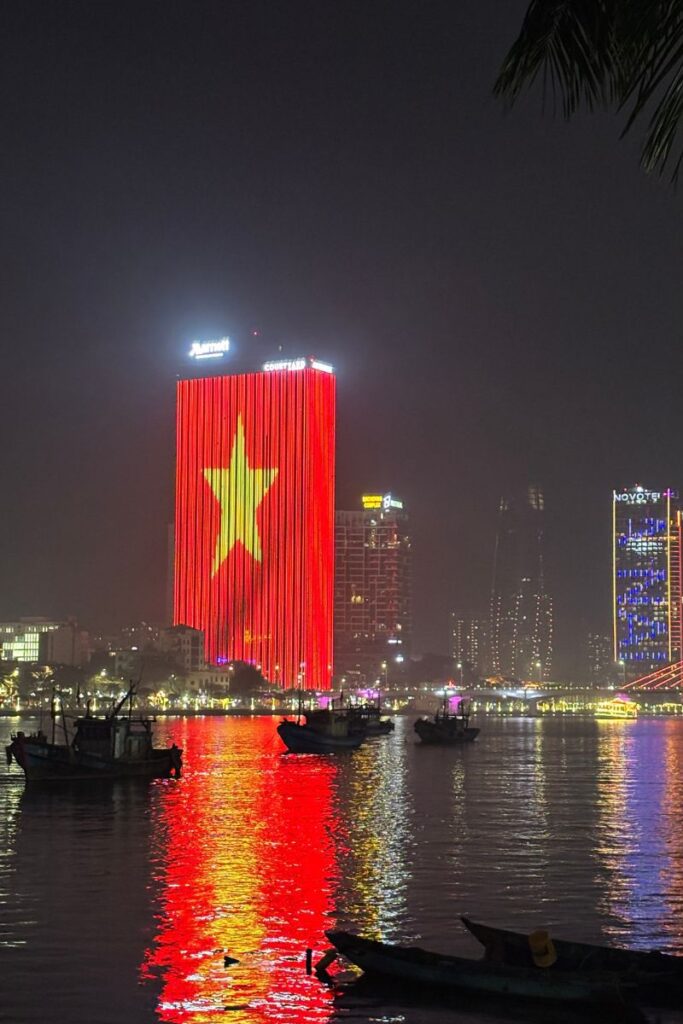
The night before the first day of Tet, you’ll find what is perhaps the nation’s #1 best fireworks show taking place above the Han River (sông Hàn). Thousands of spectators line the riverwalk next to Da Nang’s famous Dragon Bridge (Cầu Rồng) to get a front view of the fireworks, as well as the fire and water show on the bridge.
If you’d prefer a more natural setting, head out to Son Tra Peninsula on the north end of town. This mountainous jungle-covered piece of land jutting into the East Sea is home to the Lady Buddha, which stands watch over the city and is visible from Da Nang’s cosmopolitan beachfront. If you’re lucky, you could find locals praying for a prosperous year in the temple at the base of the 67-meter (220-foot) tall tower.
Insider Tip: Other than the fireworks the night before the Lunar New Year, Da Nang offers a relatively relaxed Tet experience. Many city residents leave to enjoy family time during the holiday. However, in the beach area where most visitors congregate, you’ll still find restaurants, shops, and other businesses operating as usual.
Hue
The former capital of Vietnam, Hue, is known for its deep-rooted cultural celebration of Tet. In the Imperial City, you can get a taste of how Vietnamese royalty spent Tet in the nineteenth century, with reenactments of performances that the famed Emporer Gia Long may have seen.
You may even witness a traditional pole-raising ceremony (Lễ Dựng Nêu), where a 20-meter (60-foot) bamboo pole adorned with a red flag, bells, and bundles of betel leaves or rice husks is raised to the sky. Historically, this ceremony was held in the Imperial City to mark the beginning of Tet. Traditional beliefs are that the bamboo pole encouraged peace and warded off evil spirits.
Eye-catching pagodas such as Thien Mu, Từ Hiếu, and Huyền Không Sơn Thượng attract local worshippers who turn out to pray, honor ancestors, and find peace. Many locals also wear the traditional Vietnamese tunic known as the áo dài, adding to the mystical experience of Tet in Hue. You’ll find no shortage of families wearing these beautiful garments and posing for photographs in the Imperial City and along the walking areas next to the Perfume River (Sông Hương).
Insider Tip: Hue has a relatively sleepy atmosphere for Tet. However, if you’re looking for an authentic cultural Tet experience in a sizable city without too many tourists, Hue is where you should spend the holiday. It’ll be like living in the past but with modern amenities nearby.
Other Areas/Countryside
The breathtaking Vietnamese countryside, covered with mountainous jungle, verdant rice fields, and quaint villages, offers an entirely genuine Tet experience. In these places, Tet is centered around community-based celebrations filled with warmth, kindness, and plenty of culinary delights and libations.
In some remote areas, locals may be playing traditional Tet games such as bamboo swing (Đánh Đu), pot smashing (Đập Niêu Đất), human chess (Cờ Người), or tug of war (Kéo Co). These friendly competitions, which date back centuries and can’t be found in Vietnam’s big cities anymore, are central to bringing small communities together during Tet.
Local markets transform into Tet markets, where people buy Tet goods like red banners, calligraphy scrolls, handwoven baskets, bamboo crafts, incense sticks, dried sweets, rice cakes, and rice wine. Families gather to drink rice wine and feast while toasting “một, hai, ba, dô!” (one, two, three, drink), trading stories, and generally having a good time. In many cases, families will travel around to multiple homes to continue the party well into the night.
Insider Tip: In the countryside of Vietnam, you’ll get a 100% authentic Tet experience that gets to the core of the traditional celebration. It might take you off the beaten path, but it’ll be worth it.

What Activities Can You Do To Celebrate Tet In Vietnam?
If you want to celebrate Tet holiday in Vietnam, here are some activities you can partake in to get the most out of your time here.
1. Explore Tet Markets
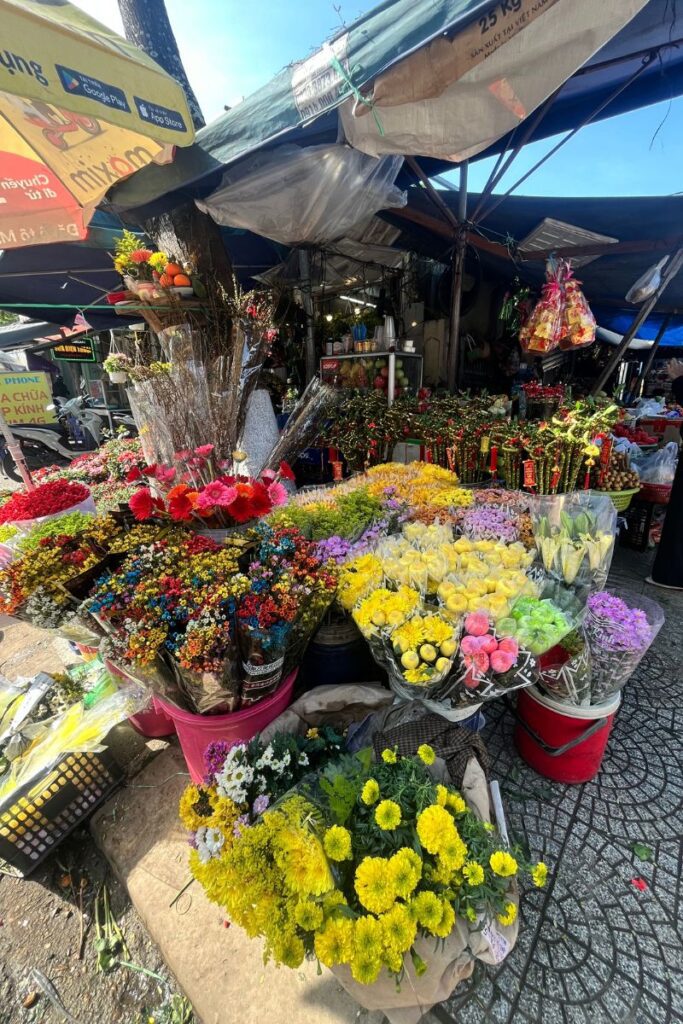
Tet Markets are a must-see when celebrating Tet in Vietnam. These oases of magic can be identified by their robust colors, which are visible in the form of Tet flowers, banners, and clothes.
Many locals buy their Tet gifts, treats, and decorations here. You can get in on the action and purchase Tet snacks like rice cakes, candied fruit, seeds, and nuts, or just walk around and take it all in. Tet markets are an excellent place to learn how locals prepare for the holiday.
Insider Tip: Tet markets are prevalent in the weeks leading up to Tet. During the primary days of Tet, they’re likely to be closed. These markets are in many small villages and all big cities such as Hanoi, Ho Chi Minh, and Da Nang.
2. Watch Tet Celebrations
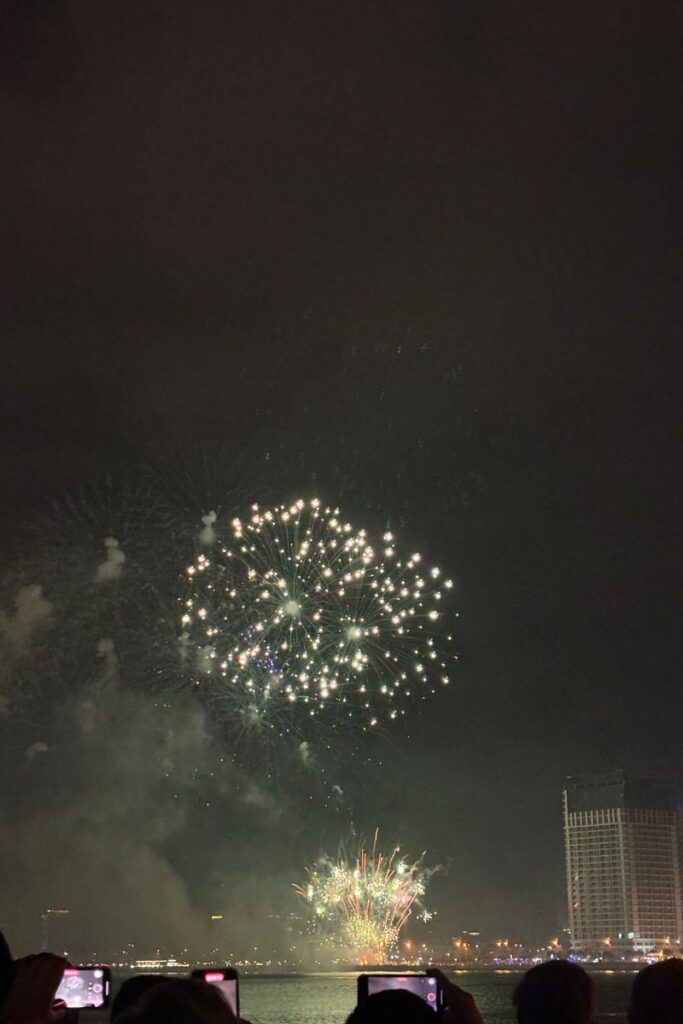
There will be plenty of Tet celebrations all over Vietnam. Fireworks, lion dances, dragon dances, musical performances, floral exhibitions, and light shows are standard.
Typically, fireworks occur in Ho Chi Minh City, Hanoi, Da Nang, Hoi An, and Hue the evening before the first day of Tet. Other celebratory events mainly occur in the days and weeks before the first day of Tet, with some occurring sporadically during the primary days of the holiday. Head to any city center, and you’ll likely find these events taking place.
Insider Tip: Tet celebrations are undoubtedly worth seeing. We love watching the fireworks shows, visiting the flower streets, and listening to the musical performances, which are usually free. You’ll have the best chance of seeing Tet celebrations in the days just before Tet begins.
3. Visit Temples & Pagodas
Before and during the peak of Tet, many locals flock to temples and pagodas to ask for forgiveness, pray for a prosperous, healthy new year, and offer well wishes for the souls of their ancestors.
If you’re fascinated by Buddhist culture or simply enjoy walking around temples and pagodas, Tet is an excellent opportunity to indulge your interests. These places of worship can be packed in the days before Tet. During the peak of Tet, you may also notice many temples and pagodas open, but with substantially less traffic, though some worshippers will surely be around.
Insider Tip: Many Vietnamese consider Tet a holy time. They visit their local temples and pagodas to worship, express gratitude, clear bad karma, make offerings, and seek spiritual guidance. If you go, do your best to be respectful. Dress appropriately, remove shoes in sacred areas, and keep talking to a minimum.

4. Try Giving Lucky Money
Giving lucky money is a signature part of Tet. As mentioned above, Vietnamese often gift lucky money to children, elderly family members, and respected service workers.
You can find lucky money envelopes for sale everywhere if you’d like to participate. After securing your red envelopes, you can gift a dollar or two (20-50k VND) to children with whom you have a personal relationship or about four to eight dollars (100-200K VND) to older people with whom you have a personal relationship. If you like, you could also offer some lucky money (50-200k VND) to housekeepers or security guards.
Insider Tip: You don’t have to give lucky money, especially for a foreigner. However, it’s an easy and fun way to participate in the festivities, and many people appreciate the gesture. We usually give lucky money to the kids we’ve come to know in our neighborhood and service workers who we feel do exemplary work.

5. Attend A Tet Feast (If Invited)
If you’re fortunate enough to be invited to a Tet feast, either by friends, family, or homestay hosts, it’s worth accepting. This is the pinnacle of Tet experiences!
Tet feasts are very personal, family-focused gatherings. There are offerings made to ancestors, plenty of good food, banter, cheer, and drinking. Toasts of good health and prosperity are made with rice wine, beer, and tea. Lucky money is exchanged, and the eating begins. After dinner, you may take part in popular Tet games and visit neighbors to shout “Chúc mừng năm mới!” (Happy New Year!).
Insider Tip: Tet feasts are all about connecting with close friends and family. If you’re invited to one, you should feel honored! If you go, greet elders first when you arrive (a sign of respect), avoid discussing negative topics, and bring a small gift (a bottle of wine or liquor, sweets, fruit, or calligraphy scrolls are good Tet gifts).
What Not To Do During Tet in Vietnam
Now that you know where to go and what to do for Tet in Vietnam, what about things you shouldn’t do during Tet in Vietnam?
Here’s a list of faux pas that should be avoided.
1. Don’t Wear Black/White
In Vietnam, black and white are traditionally considered colors of mourning. Both are regularly worn during funerals, and although many fashionable Vietnamese wear black and white clothing at other times (most of the year), these colors should be avoided during Tet.
Insider Tip: Dress brightly! Red and yellow are traditional colors of prosperity and good fortune in Vietnam. Green, pink, and purple are also acceptable, as they’re also associated with positivity.
2. Don’t Be Overly Negative/Aggressive
Negative talk and aggressive behavior during Tet can bring about bad feelings, which may be a bad omen for the coming year. Avoid bringing up sickness, death, or financial issues, and try not to take an aggressive stance on anything, as this can have negative connotations.
Insider Tip: Smile and be cheerful. Greetings like “Chúc mừng năm mới!” (Happy New Year!), “Sức khỏe dồi dào!” (Wishing you good health!), and “An khang thịnh vượng!” (Wishing you peace and prosperity!) are all greatly appreciated.
3. Don’t Sweep The Floor On The First Day Of Tet
Though Vietnamese do a deep cleaning of their homes on the days before Tet, cleaning on the first day of Tet is seen as poor form. It’s believed that the first day of the Lunar New Year brings good luck, and by sweeping the floor, you’re sweeping that luck away.
Insider Tip: Don’t clean your living space (or someone else’s) on the first day of Tet. Sweeping the floor or taking out the garbage are considered bad omens. However, after that first day, it’s perfectly acceptable to clean up as you usually would.
4. Don’t Break Things (If Possible)
Traditional beliefs say that breaking plates, glasses, bowls, and mirrors during Tet is a sign of bad luck to come. These things can represent family separation, financial misfortune, or other serious issues.
Insider Tip: Be careful with dishes and glassware during Tet. If you’re worried, avoid mirrors and use plastic utensils and dishware. However, if you do break something, say, “Mùng một Tết, mùng hai Tết, mùng ba Tết!” (First day of Tet, second day of Tet, third day of Tet!). This is supposed to reverse the bad luck caused by breaking something.
5. Don’t Refuse Lucky Money (In Most Cases)
Receiving lucky money isn’t just about getting some cold hard cash. It’s more about another person wishing you luck, happiness, and blessings in the new year. So, if you’re offered lucky money, accepting it with gratitude is respectful.
Insider Tip: It’s best to take lucky money with both hands and a smile while wishing your benefactor a happy new year. Of course, if you’re uncomfortable taking someone’s money, it’s okay to refuse, but be overly polite about it, as this helps the person offering lucky money save face.

Should You Celebrate Tet In Vietnam?
Vietnam Tet celebrations are a genuinely unique experience. You definitely can’t find them anywhere else in the world. So, if you’re considering spending the Tet holiday in Vietnam, we say do it!
There’ll be some slowdowns and inconveniences; businesses will shutter their doors, restaurants will add a Tet surcharge, transportation will be harder to come by, some prices will surge, cities will feel strangely empty, and some essential services will be limited or unavailable.
However, if you want to understand the nuances of Vietnamese culture, there’s no better time to visit this lovely country. So pack your áo dài, grab your conical hat, bring your appetite, and prepare to be mesmerized—Tet in Vietnam awaits!


Leave a Reply